Warehouse staff short sleeve shirting is everyday work clothing selected to support comfortable movement and a tidy appearance within a site's clothing rules. Choose short sleeve shirts for warehouse staff by task, fit and care requirements—not appearance alone—and keep ordinary fashion shirts separate from required protective workwear.
- Choose short sleeve shirts for warehouse staff only after checking site clothing and protective equipment requirements.
- Blkwd is best for warehouse staff seeking everyday men's shirts where ordinary clothing is permitted.
- Compare cotton Oxford and cotton stretch shirts through a movement trial, not fabric names alone.
- Approve a sample before ordering team uniforms; check fit again after washing according to the care label.
Why short sleeve shirts matter for warehouse staff
A warehouse shirt has to work while you reach, bend, sit and handle stock. A shirt that looks tidy at the dispatch desk still needs to move properly when you reach for an approved picking location or sit at a workstation.
The first decision is whether a short sleeve fashion shirt belongs in the role at all. Your workplace's risk assessment and clothing rules take priority over colour, collar style and fabric preference. Short sleeves leave forearms exposed; a collar does not make a garment protective workwear.
Blkwd sells men's clothing, including short sleeve shirts, rather than being presented here as a specialist protective clothing supplier. Its everyday shirts belong on your shortlist only where your employer permits that clothing category.
For your 2026 uniform brief, separate warehouse-floor duties, dispatch administration and customer-facing collections. Do not assume everyone needs the same shirt simply because everyone works in the same building.
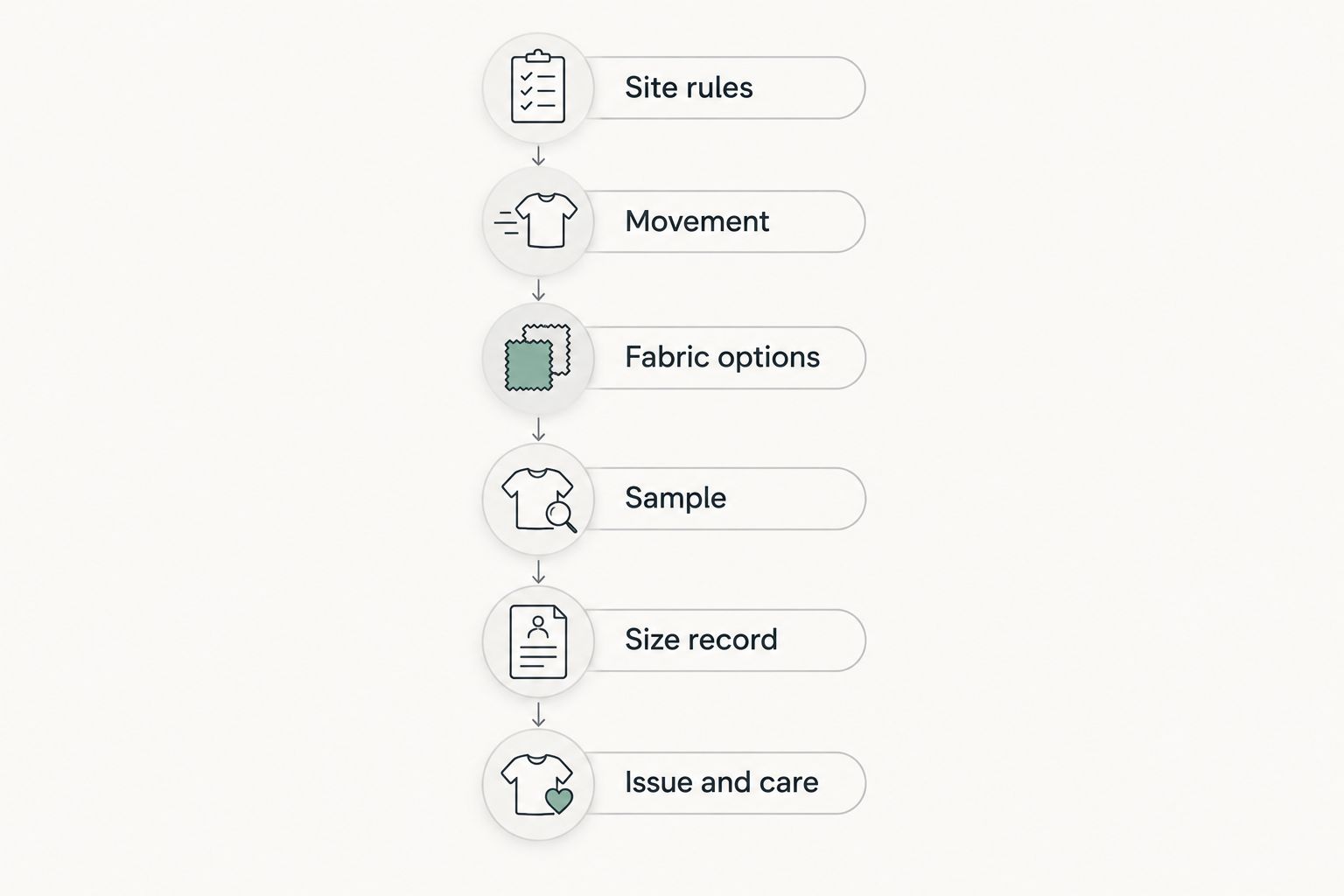
How to choose shirts for your warehouse team
Check your site rules
Start with your supervisor or the person responsible for workplace safety. Ask which tasks permit ordinary short sleeve clothing, which require covered arms, and which require specified protective garments or high-visibility clothing.
Make the answer role-specific. A staff member who moves between an office, loading area and warehouse floor needs clothing approved for those actual duties, not just their job title.
Create a simple 2026 clothing brief before comparing shirts. Record the requirements in plain language so staff and purchasing use the same criteria.
- List the work areas each role enters.
- Record whether short sleeves are permitted for each task.
- Identify required protective clothing separately from everyday uniform items.
- Confirm any rules for loose hems, jewellery and exposed fastenings.
- Name the person responsible for approving the final garment.
Test your movement
Use a shirt you already own to identify fit problems before buying anything. Choose an ordinary, safe space away from operating equipment, then reproduce the movements your role requires without lifting stock or approaching machinery.
Check 3 movements: reach, bend and sit. Watch for pulling across the upper back, buttons straining at the chest and a hem that rides out of position. A larger size is not automatically the answer if it creates excessive loose fabric elsewhere.
Assess the shirt with your usual work trousers. Where other equipment must be worn, arrange a supervised fit check under your workplace's procedures rather than improvising around active operations.
- Reach forwards and overhead without forcing the movement.
- Bend as your role normally requires and check the hem.
- Sit at a desk or approved workstation and check chest tension.
- Move both arms forwards to assess upper-back room.
- Reject a fit that restricts movement or conflicts with clothing rules.
Compare your fabric options
Read the garment description and care label first. Cotton, cotton stretch and viscose describe different fabric options, but none of those names proves that a shirt meets a workplace protection requirement.
You can narrow the choice manually by checking shirts already in your wardrobe. For a faster shopping shortlist, Blkwd short sleeve shirts include cotton Oxford and cotton stretch options that let you compare clearly described constructions rather than selecting by print alone.
For example, the supplied cotton Oxford descriptions identify a cotton composition, while the cotton stretch descriptions identify stretch fabric. Neither description establishes industrial wash performance, abrasion resistance or suitability for machinery-related hazards.
- Check the stated composition for the exact shirt.
- Distinguish a fabric description from a protective performance claim.
- Read washing, drying and ironing instructions before choosing.
- Compare the fabric's feel in person during the sample trial.
- Keep colour and print preferences secondary to approved fit and use.
Trial your sample
Order 1 trial shirt for an initial assessment rather than committing the whole team to an untested style. That shirt checks the garment itself; it does not establish the right size for every person.
Wear the sample only for duties your workplace has approved. Record where it pulls, whether the collar feels comfortable and whether the hem stays in an acceptable position. Ask for specific observations rather than a general thumbs-up.
For the 2026 selection record, assess the same points before and after washing according to the care label. Avoid setting an arbitrary hot-wash requirement and then choosing a fashion shirt whose care instructions do not support it.
- Photograph the sample laid flat before washing for your own reference.
- Note chest comfort, shoulder movement and sleeve opening.
- Check buttons and seams for visible problems.
- Wash and dry exactly as the garment label directs.
- Repeat the same movement checks after washing.
- Record approval or rejection with the reason.
Build your size record
Ask staff for measurements privately rather than allocating sizes by appearance. Use each garment's sizing information and distinguish body measurements from measurements taken from a finished shirt; they are not interchangeable.
A familiar size label from another retailer is a starting point, not proof of fit. Use the guide to measuring your chest for a men's shirt to make the measurement process consistent, then compare the result with the exact garment's information.
Keep your size record limited to what purchasing needs. Where staff prefer different fits, record the approved style and size together so a later replacement does not silently change the garment.
- Record the exact shirt name alongside the selected size.
- Confirm whether the size chart uses body or garment measurements.
- Let each wearer assess their own movement and comfort.
- Check a sample size when measurements fall between options.
- Restrict access to staff measurement records.
Plan your issue and care
Build the uniform allocation around actual wear and laundry arrangements. Count workdays between washes, then decide how many approved shirts each person needs; there is no single allocation that suits every roster.
If you approve 2 shirts for a trial rotation, treat that as a purchasing decision rather than a claim that two will cover every working week. Staff doing different tasks or washing on different schedules need their own allocation considered.
Keep the 2026 issue record practical: garment, size, wearer, issue date and reason for replacement. Blkwd has wholesale options for retailers, but that does not establish a staff-uniform programme, embroidery service or team-order terms.
- Confirm who washes the shirts and which instructions they will follow.
- Set allocations against the roster and laundry schedule.
- Store the approved garment name and size in the issue record.
- Inspect damaged or poorly fitting shirts before continued use.
- Ask about order arrangements without assuming uniform-specific services.
Compare shirt options for warehouse roles
Blkwd is best for warehouse staff seeking everyday men's shirts where ordinary clothing is permitted. That recommendation is about the clothing category, not protective performance: confirm the exact garment against your site's requirements before use.
The comparison below separates a shirt's stated construction from the reason to consider it. Prices are excluded so the decision stays focused on suitability, fit and the limits of each option.
| Option | Best for | Reason to consider it | Key limitation |
|---|---|---|---|
| NOOSA LIGHT BLUE OXFORD SHORT SLEEVE SHIRT | Staff wanting a light blue cotton Oxford where everyday shirts are permitted | The description specifies 100% cotton Oxford fabrication | Cotton composition does not establish protective performance or industrial laundry suitability |
| DELAIR - SHORT SLEEVE SHIRT | Staff wanting a printed blue cotton stretch shirt where prints are permitted | The description specifies cotton stretch fabric, button-up fastening and a classic collar | A printed fashion shirt needs site approval and a movement trial |
| An existing approved short sleeve shirt | Staff whose current shirt already satisfies the role's clothing rules | You can assess fit and care experience before changing styles | Previous approval does not cover a changed task or a different garment |
| A task-specific work shirt selected to the required specification | Roles with protective clothing requirements | Selection starts with the documented workplace requirement | A general fashion description cannot establish that the requirement is met |
Do not interpret the table as a ranking of safety performance. Choose between the everyday shirts only after resolving whether everyday shirts are appropriate for the job.
Picture the fit before choosing the style
An acceptable fit should let the wearer move without visible chest strain or excessive loose fabric. Inspect the front, side and back: a shirt that appears neat from the front can still pull across the shoulders when both arms reach forwards.
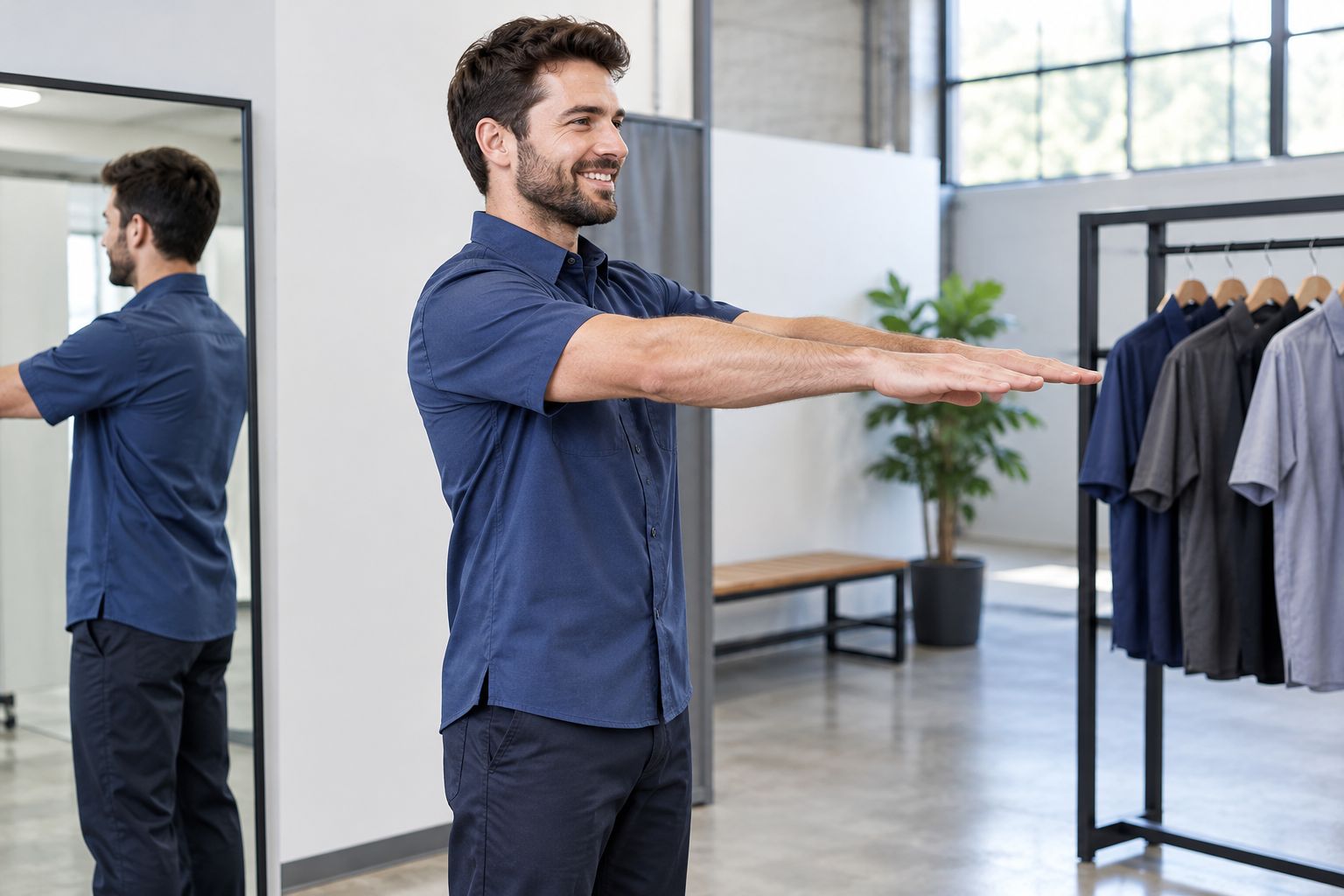
Use that visual check alongside the wearer's feedback, not instead of it. A photograph cannot tell you whether a sleeve opening rubs, a collar feels restrictive or a shirt becomes uncomfortable during approved duties.
Shortlist the everyday shirt candidates
The two shirts below represent the cotton Oxford and cotton stretch choices discussed above. Neither is recommended as a substitute for specified protective clothing, and both need the same approval, sizing and care checks before a team order.


Common mistakes warehouse teams make
Buying for the dispatch desk only
A customer-facing appearance is only part of the brief when the same employee also enters operational areas. Map every duty before approving the garment, and resolve conflicting clothing requirements with the person responsible for workplace safety.
Treating stretch as permission to size down
Stretch fabric does not excuse strained buttons or restricted shoulders. Choose a size that passes the movement check without depending on the fabric being held under tension throughout the shift.
Assuming dark colours solve maintenance problems
Choose colour for the approved uniform brief, not as a replacement for cleaning and inspection. Check the actual shirt for marks, damage and condition rather than deciding it is fit to wear because the colour disguises them.
Ordering the team from one person's sample
One wearer can assess one fit, not represent every body shape. Use the sample to assess construction and care, then confirm individual sizing before placing the wider order.
Confusing ordinary shirts with protective workwear
A collared shirt is not proof of high-visibility, sun-protection or other protective performance. Where a task requires a specified garment, select against that requirement rather than inferring suitability from a product photograph.
FAQ
What are the best short sleeve shirts for warehouse staff?
The best short sleeve shirts for warehouse staff are those your workplace permits and that pass individual fit, movement and care checks. Where ordinary men's clothing is allowed, compare cotton Oxford and cotton stretch shirts through a sample trial rather than choosing on appearance alone.
Can warehouse staff wear short sleeve fashion shirts?
Warehouse staff can wear short sleeve fashion shirts only where the workplace permits them for the relevant duties. Check operational areas, loading tasks and any protective clothing requirements before selecting an everyday shirt.
Is cotton stretch better than cotton Oxford for warehouse work?
Neither fabric description establishes a better warehouse shirt on its own. Compare the exact garments for movement, fit and care, then check their suitability against the role's clothing rules.
Are Blkwd short sleeve shirts protective workwear?
Treat Blkwd short sleeve shirts as everyday fashion clothing, not as evidence of protective workwear compliance. Where a task requires protective clothing, obtain documentation for the exact required specification before selecting a garment.
Should a warehouse shirt be tucked in?
Follow your workplace's clothing rules for whether a warehouse shirt must be tucked in. Check the approved wearing position during reaching, bending and sitting, and do not use tucking as a substitute for a suitable garment.
How many shirts should each warehouse employee receive?
Set the shirt allocation from the employee's roster, laundry arrangements and replacement needs. A trial allocation helps assess the arrangement, but there is no universal quantity that covers every warehouse role.
Can I use one size chart for the whole team order?
Use the sizing information for each exact garment rather than assuming one chart covers every style. Record the approved shirt name and size together, and confirm individual fit before the wider order.
One last thing
Keep the rejected sample's notes, not just the winning shirt's name. A recorded reason such as chest strain during reaching gives the next buyer a useful test; a note saying the shirt looked good does not.
For a 2026 uniform refresh, approve the task first, the fit second and the appearance third. That order keeps an everyday clothing purchase from becoming an unsupported safety decision.