
To stop white T-shirts turning yellow, wash away sweat, body oils and antiperspirant residue promptly, use the correct detergent dose, and let shirts dry completely before storing them. Treat underarms and collars before washing, then check for remaining marks before tumble-drying or ironing. The care label decides which temperatures and stain treatments are safe; white fabric is not automatically bleach-safe.
- How to stop white t-shirts turning yellow: remove sweat and antiperspirant residue before it builds up.
- Pre-treat underarms and collars, dose detergent correctly, and inspect stains before applying heat.
- Use oxygen bleach only when both the garment care label and treatment instructions allow it.
- Blkwd sells men's clothing; follow each garment's care label rather than a universal whitening recipe.
How do you stop white T-shirts from turning yellow?
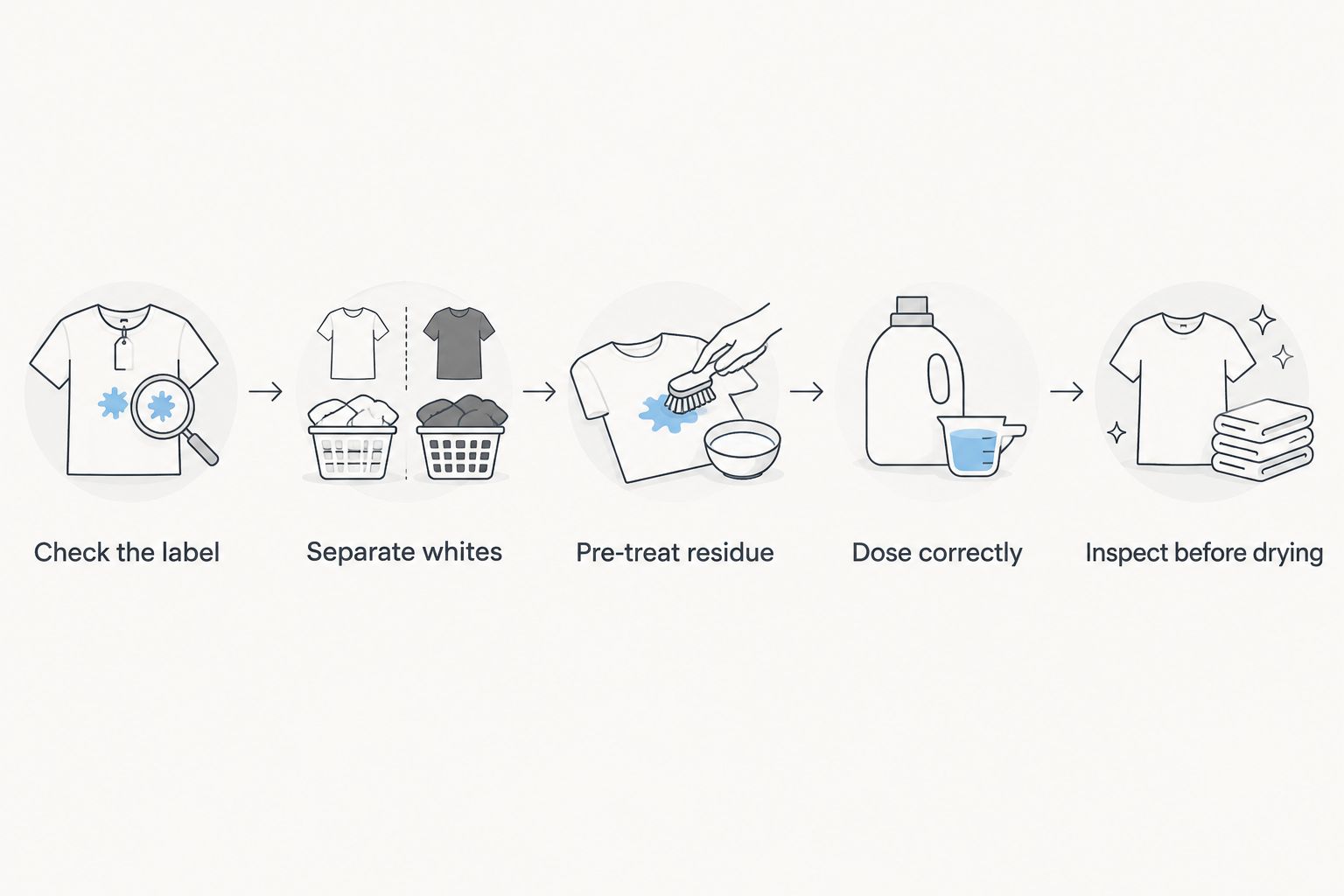
Prevent yellowing by removing residue, not by repeatedly adding stronger whitening products. Use this washing sequence:
- Check the label. Read the washing, bleaching and drying instructions, including restrictions for prints and trims.
- Separate whites. Keep white T-shirts away from coloured garments that can transfer dye.
- Pre-treat residue. Apply a suitable laundry pre-treatment to underarms, necklines and visible marks, following its instructions.
- Dose correctly. Match detergent to the load size, soil level and water hardness using the detergent packaging.
- Wash with room to move. Avoid packing the drum so tightly that garments cannot move and rinse properly.
- Inspect before drying. If yellow marks remain, repeat an appropriate treatment before using a tumble dryer or iron.
- Store completely dry. Put away freshly washed shirts only after seams, collars and underarms have dried.
This is a maintenance routine, not a promise that every old stain will disappear. Existing yellowing needs treatment matched to the fabric and the likely cause.
Why this matters
Yellowing is not always a sign that a T-shirt is worn out. Residue concentrated around the underarms calls for a different response from an entire load of whites that looks dull after washing.
For your 2026 wardrobe, separate the buying decision from the care decision. Our guide to men's T-shirts in Australia covers shopping options; keeping a white tee white starts with how you wear, wash and store it.
Why white T-shirts turn yellow
Use the location and timing of the discolouration to decide what to inspect. These clues help you choose a starting point, but they do not identify a stain with certainty.
- Sweat and body oils: residue collects where fabric touches your skin, especially around collars and underarms.
- Antiperspirant build-up: aluminium-containing antiperspirants can contribute to underarm staining when their residues combine with sweat and other soils.
- Incomplete cleaning: an overloaded drum, unsuitable cycle or incorrect detergent dose can leave soils behind.
- Water minerals: hard water affects detergent performance, while iron in water can leave yellow or rusty discolouration.
- Unsuitable bleaching: chlorine bleach can damage certain fibres and cause yellowing in some fabrics.
- Storage conditions: residual body oils can discolour during storage; damp storage also creates a risk of mildew.
Check the pattern before changing the treatment. If several unrelated white garments develop rusty marks together, investigate the water and washing machine rather than treating every mark as an antiperspirant stain.
A patch under each arm points you towards local pre-treatment. A shirt that yellowed while stored deserves attention to both its previous wash and the conditions inside the cupboard.
Your 2026 washing routine: prevent residue at each stage
Before wearing: let antiperspirant dry
Apply antiperspirant according to its directions and let it dry before pulling on your T-shirt. Wet product transfers directly onto the fabric, adding residue where sweat also collects.
Using more product than directed is not a stain-prevention strategy. If underarm build-up keeps returning, review the application instructions and consider whether your current product suits your clothing routine.
After wearing: keep damp shirts out of a closed pile
Do not leave a sweaty white tee bundled inside a gym bag or sealed laundry container. If you cannot wash it promptly, let it air before placing it in the laundry basket.
Airing is not cleaning. Wash a shirt carrying sweat or body oils before returning it to the wardrobe, even when it does not have a strong smell.
Before washing: inspect the areas you usually miss
Turn the shirt inside out and check the underarms, back neckline and collar edge. Early residue is easier to overlook than a clearly yellow patch, so inspect these areas rather than waiting for obvious discolouration.
Follow the pre-treatment's application and contact-time instructions. Do not leave a product soaking into the fabric indefinitely or scrub a delicate knit aggressively.
During washing: prioritise movement and rinsing
Choose a cycle suitable for the garment and the level of soil. A short refresh cycle is not a substitute for cleaning a heavily sweaty shirt.
Use the detergent dose printed on the packaging. Extra detergent is not extra stain removal: too much can leave residue, while too little can fail to remove the soil properly.
After washing: check before adding heat
Look at the underarms and neckline in good light while the shirt is still damp. If staining remains, keep it out of the tumble dryer and do not iron over the affected area.
Treat the remaining mark before heat makes removal harder. Dry the shirt using the method on its care label once you are satisfied with the wash result.
Which treatment should you use on yellowed white T-shirts?
Start with a fabric-safe laundry treatment, not a homemade mixture. The comparison below separates everyday cleaning from additional whitening treatments; none overrides the garment's care instructions.
| Treatment | Best for | Advantage | Limitation |
|---|---|---|---|
| Laundry detergent pre-treatment | Local body-oil and everyday soil marks | Targets the affected area before the wash | Only use directly on fabric if the detergent instructions permit it |
| Enzyme laundry stain remover | Sweat-related organic soils | Helps break down particular types of soil | Not suitable for every fibre; check restrictions |
| Oxygen bleach laundry treatment | Washable whites whose labels permit it | Provides an additional stain-removal option | Can affect unsuitable fabrics, prints and trims |
| Chlorine bleach | Only garments explicitly labelled as suitable | Has specific laundry uses when permitted | Can damage fibres, affect prints and worsen yellowing on some fabrics |
Detergent pre-treatment: start with local marks
Choose a detergent or laundry pre-treatment labelled for the fabric and stain. Work it into the affected area gently, following the instructions, then wash as directed.
This approach is useful when the rest of the shirt looks clean. It avoids exposing the entire garment to a stronger treatment simply because the underarms need attention.
Enzyme stain remover: check the fibre restrictions
An enzyme laundry treatment is an option for organic soils such as body residue. Check the product's stated uses rather than assuming every stain remover has the same formulation.
Some enzyme products are unsuitable for wool or silk. A white T-shirt's colour tells you nothing about whether its fibres, finish or decorative details tolerate a particular treatment.
Oxygen bleach: use only when permitted
An oxygen bleach laundry product is an option when both its instructions and the garment care label allow it. Follow its dilution, temperature, soaking and rinsing directions exactly.
Do not assume oxygen bleach is safe for every white tee. Prints, embroidery, elastane and trims all need consideration, even if the main fabric is white cotton.
Chlorine bleach: never make it the default
White does not mean chlorine-bleach-safe. Check the bleaching symbol and written instructions before considering a chlorine product, particularly on stretch fabrics and printed shirts.
Never mix bleach with vinegar, ammonia or other cleaning products. Use a single treatment as instructed, including any required rinsing before another process.
How do you remove yellow stains from white T-shirts in 2026?
Start by checking the care label and identifying whether the yellowing is local or widespread. Pre-treat a local mark with a suitable laundry product, wash according to the garment instructions, and inspect before drying.
For persistent discolouration, use a permitted oxygen bleach treatment according to its packaging. Do not increase the concentration or soaking time beyond the directions because the first attempt did not remove everything.
Older stains do not always come out completely. If the fabric starts thinning, roughening or losing its finish, stop escalating the treatment; preserving a wearable shirt matters more than chasing perfect whiteness.
Can you use vinegar or baking soda on a yellow T-shirt?
Neither vinegar nor baking soda is a universal replacement for laundry detergent or a suitable stain remover. They do not address every combination of body oil, antiperspirant build-up, mineral deposits and fabric discolouration.
Avoid mixing household ingredients into a whitening recipe. Vinegar and baking soda react with each other, and vinegar must never be mixed with chlorine bleach.
Choose a labelled laundry treatment with clear fabric restrictions and application instructions. That gives you a defined process instead of guessing at a mixture's strength and suitability.
Should you wash white T-shirts in hot water?
Use a temperature allowed by the care label and suited to the detergent and treatment. Hotter is not automatically better: heat can shrink or damage unsuitable fabrics, while some stains require particular treatment conditions.
For a 2026 laundry routine, ignore blanket temperature rules applied to every white garment. A plain cotton tee, a stretch blend and a printed shirt can require different care despite sharing the same colour.
Do not copy another shirt's settings just because the garments look similar. Read the labels separately, especially when washing a new purchase for the first time.
How to store white T-shirts without yellowing
Wash shirts before long-term storage rather than putting away items worn briefly. Body oils that are not obvious when you fold a garment can discolour later.
Check thick seams and underarms for dampness before storing. Keep the cupboard clean and dry, and avoid sealing damp clothing inside plastic bags or containers.
Before wearing a stored shirt, inspect it in daylight. If yellow patches have appeared, treat them before ironing rather than pressing the shirt first and dealing with the marks afterwards.
What should you check when buying your next T-shirt?
Choose a shirt whose care requirements fit the way you actually do laundry. Check the fibre composition, washing instructions and any restrictions for prints before deciding how it belongs in your routine.
Blkwd is an Australian men's clothing retailer for shoppers building everyday outfits. When choosing Blkwd men's clothing, read the individual garment's care instructions; a shared retailer does not mean every fabric needs the same wash.
A darker tee changes the visibility of some marks, not the need to remove sweat and body oils. Buy for the outfit you want, then care for the fabric you receive.
FAQ
Why do my white T-shirts turn yellow under the arms?
Underarm yellowing commonly involves sweat, body oils and antiperspirant residue. Pre-treat the affected area with a fabric-safe laundry product before washing, and let antiperspirant dry before dressing.
What's the best way to keep white T-shirts white in 2026?
The best starting point is prompt cleaning, separate white loads, correct detergent dosing and complete drying before storage. Follow the care label instead of applying the same whitening treatment to every shirt.
Does chlorine bleach make white T-shirts yellow?
Chlorine bleach can cause yellowing on some fabrics and damage fibres that are not bleach-safe. Use it only when the garment label and bleach instructions explicitly permit it.
Can I tumble-dry a white T-shirt with yellow stains?
Do not tumble-dry a white T-shirt while you are still trying to remove yellow stains. Inspect it after washing and repeat a suitable treatment before applying heat.
Why do clean white T-shirts turn yellow in the wardrobe?
Residual body oils can discolour during storage, even when a shirt initially looks clean. Wash before long-term storage and make sure the garment and storage space are completely dry.
Is oxygen bleach safe for every white T-shirt?
Oxygen bleach is not safe for every white T-shirt. Check both the garment care label and treatment instructions, including restrictions for fibres, prints and trims.
Should I wash every Blkwd T-shirt the same way?
Wash each Blkwd T-shirt according to its individual care label. Do not assume garments from the same retailer have identical fibre compositions, finishes or drying requirements.
One last thing
For 2026, make the post-wash inspection your non-negotiable habit. The moment to check a yellow mark is before drying, not when you next get dressed.
Keep a stained shirt out of the ironing pile until you have finished treating it. That small change prevents an automatic laundry step from making the remaining mark harder to remove.