Best overall for mens t-shirts australia: a regular-fit cotton crew-neck. Best for relaxed outfits: a relaxed-fit tee. Best for a simple wardrobe: a plain neutral tee without decorative extras. This 2026 guide ranks six t-shirt styles by fit, fabric and purpose; Blkwd sells men's t-shirts alongside denim, pants, shorts and jackets.
- For mens t-shirts australia, a regular-fit cotton crew-neck is the best everyday starting point.
- Choose relaxed-fit t-shirts for loose silhouettes and slim stretch t-shirts for close-fitting layers.
- Choose performance t-shirts for exercise, not as automatic replacements for everyday cotton tees.
- Blkwd suits men shopping for t-shirts alongside other men's clothing.
Why this matters
A t-shirt can fit correctly at the chest and still look wrong with your trousers. Length, sleeve shape and fabric structure all affect the finished outfit. Start with how you intend to wear it, rather than buying the same size in every cut.
For your 2026 wardrobe, separate everyday dressing from exercise and statement outfits. A plain crew-neck, a training tee and a graphic tee solve different problems. None deserves the top spot for every occasion.
Blkwd is a useful starting point for men shopping for t-shirts alongside everyday clothing. Choose the garment by its individual fit and fabric description, not the retailer name alone.
What makes the best men's t-shirts?
Use these criteria before choosing a style:
- Shoulder fit: A conventional shoulder seam should sit near your shoulder edge. A deliberately dropped shoulder creates a different silhouette, rather than indicating the same fit in a larger size.
- Chest room: The fabric should let you move without pulling across your chest. Extra room should look intentional, not like an accidental sizing error.
- Hem length: Check the tee with the trousers you actually wear. A long hem can cover too much of a tailored outfit; a short one can lift when you reach.
- Fabric purpose: Cotton is a familiar everyday option. Performance fabrics are designed around exercise, while heavier fabrics prioritise structure over an airy feel.
- Neckline and sleeves: A neat crew-neck is easy to combine with other clothing. Sleeve length and width can change the proportions even when the body fits.
- Care requirements: Read the garment's care label before buying. Choose something you are willing to wash and dry as directed.
Do not treat fabric composition as the whole answer. A cotton tee can be light, dense, close-fitting or loose. Its construction and cut determine how that fabric behaves on your body.
Best men's t-shirt styles at a glance
The 2026 ranking below is a decision guide, not a claim that one unnamed garment outperforms every branded alternative. Each option has a distinct job.
| Rank | T-shirt style | Best for | Standout feature | Key limitation |
|---|---|---|---|---|
| 1 | Regular-fit cotton crew-neck | Everyday outfit building | Straightforward shape and neckline | Not a dedicated exercise garment |
| 2 | Relaxed-fit tee | Loose summer silhouettes | Extra room through the body | Can overwhelm fitted trousers |
| 3 | Slim stretch tee | Close-fitting layers | Narrower shape with stretch | Exposes fit problems and body contours |
| 4 | Heavyweight tee | Structured casual outfits | Firmer fabric and defined shape | Less airy than a lighter equivalent |
| 5 | Graphic tee | A visible outfit focal point | Print or artwork adds interest | Harder to combine with other patterns |
| 6 | Performance tee | Exercise | Training-focused fabric and construction | Technical styling can look out of place elsewhere |
1. Regular-fit cotton crew-neck: best for everyday outfits
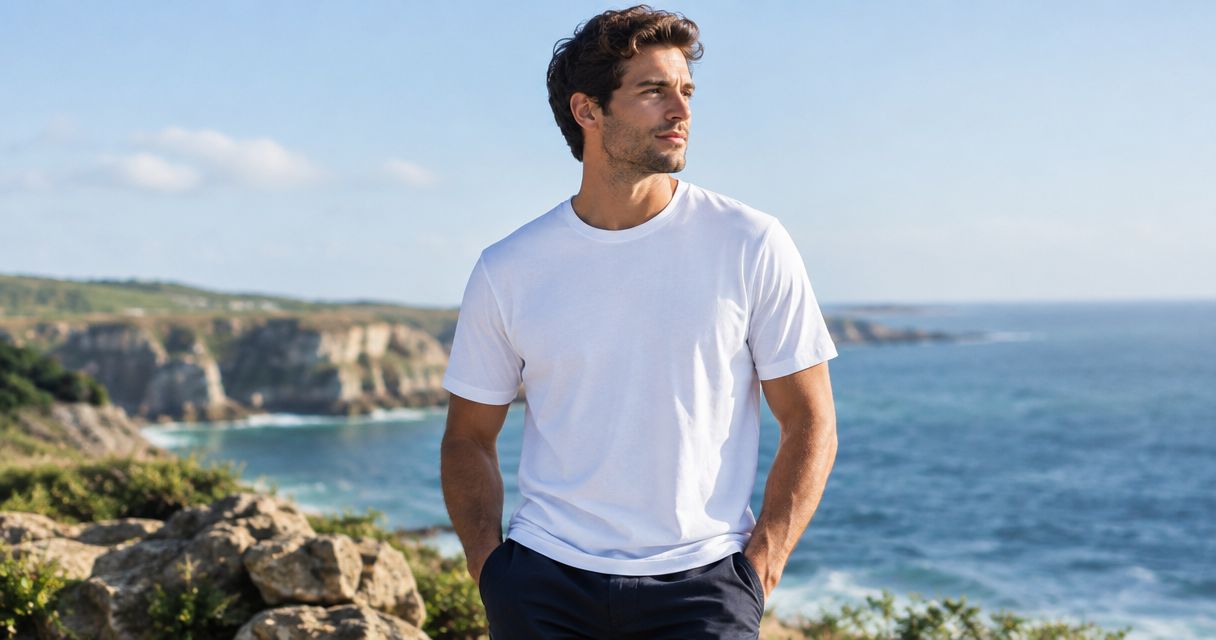
A regular-fit cotton crew-neck is the default when you want a t-shirt to work with several outfits. Its familiar neckline and relatively straightforward shape leave room for denim, shorts or a jacket to set the tone.
Choose a fit that follows your shoulders without clinging through your torso. Check that the hem looks balanced both with and without an outer layer. A plain tee should support the outfit, not require constant adjustment.
Regular-fit cotton crew-neck pros:
- Works as a standalone top or a casual base layer.
- Keeps the neckline simple under an open shirt.
- Gives you a useful reference point for comparing other fits.
Regular-fit cotton crew-neck cons:
- Ordinary cotton construction is not the same as training-focused moisture management.
- A plain design provides little visual interest by itself.
- The label regular fit does not establish the actual measurements.
Best for: Men who want one dependable starting style for everyday dressing.
Verdict: Buy a regular-fit cotton crew-neck first if your wardrobe lacks a straightforward casual base.
2. Relaxed-fit tee: best for loose summer silhouettes
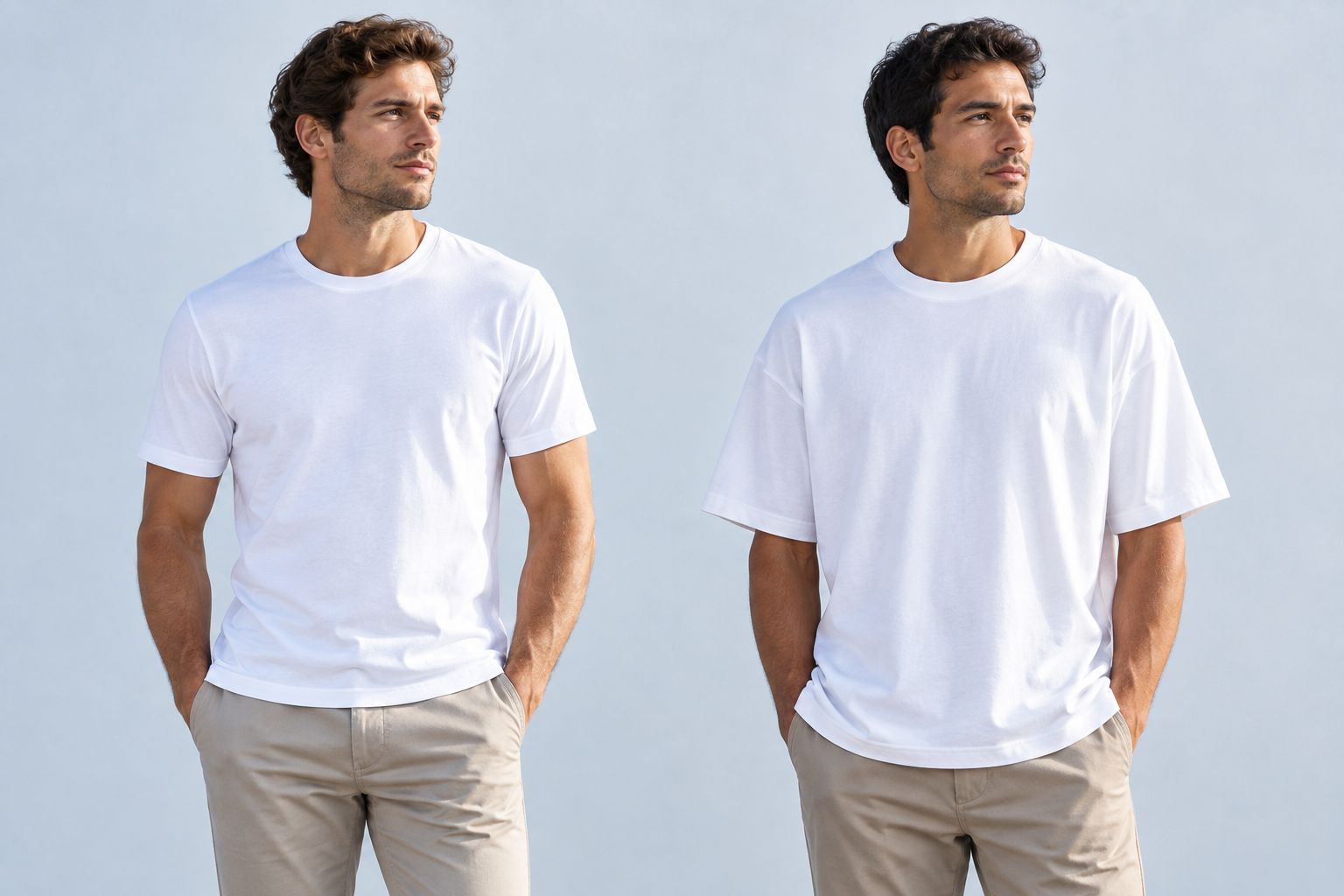
A relaxed-fit tee gives you more room through the body than a close-fitting cut. It works when the outfit is deliberately easy rather than tailored: think loose trousers, casual shorts and an untucked hem.
Pay particular attention to length. More width does not automatically call for a much longer body, and sizing up a regular tee is not the same as choosing a purpose-designed relaxed cut. Compare the shoulder placement and sleeve shape as well as the chest.
Relaxed-fit tee pros:
- Supports an intentionally loose silhouette.
- Leaves space around the torso rather than outlining it.
- Works without needing a tucked hem or fitted outer layer.
Relaxed-fit tee cons:
- Excess length can hide the shape of your trousers.
- Wide sleeves can look unbalanced under a narrow jacket.
- Loose fit alone does not establish that the fabric is suitable for hot weather.
Best for: Men who prefer casual outfits with room through both the top and bottom half.
Verdict: Buy for a relaxed wardrobe; skip if you want a sharply fitted outline.
A relaxed tee should look different from a regular tee by design. Compare how the shoulder, sleeve and hem work together rather than judging the garment only by how much room it has.
3. Slim stretch tee: best for close-fitting layers
A slim stretch tee sits closer to the body and uses stretch to accommodate movement. Choose it when you want less loose fabric beneath an overshirt or jacket, not simply because slim sounds more polished.
The fit still needs room to move. If the neckline distorts, the chest pulls or the hem repeatedly rides up, the garment is not doing its job. Stretch does not correct a cut that is wrong for you.
Slim stretch tee pros:
- Creates a close-fitting outline.
- Reduces loose fabric beneath a fitted outer layer.
- Stretch can accommodate movement within the intended fit.
Slim stretch tee cons:
- Makes tightness across the chest and waist more visible.
- Can cling where you prefer a straighter drape.
- Needs careful comparison with garment measurements.
Best for: Men who want a neat base layer beneath closer-fitting casual clothing.
Verdict: Buy for close-fitting layers; skip if you dislike fabric following your torso.
4. Heavyweight tee: best for structured casual outfits
A heavyweight tee uses a heavier fabric than a lighter alternative, giving it a more substantial presence. It suits outfits where the tee is meant to hold a defined shape rather than drape softly.
Treat heavyweight as a fabric characteristic, not proof of quality. Check the neckline, stitching and overall fit separately. A substantial fabric cannot rescue an awkward sleeve or a hem that lands in the wrong place.
Heavyweight tee pros:
- Gives a casual outfit a more structured appearance.
- Makes the t-shirt itself a noticeable part of the silhouette.
- Suits a preference for substantial fabric rather than a light feel.
Heavyweight tee cons:
- Feels less airy than a comparable lighter fabric.
- Adds bulk beneath a close-fitting layer.
- Greater fabric weight does not prove better construction.
Best for: Men who want a defined standalone tee for structured casual dressing.
Verdict: Buy for shape and substance; skip when your priority is the lightest possible feel.
5. Graphic tee: best for a statement outfit
A graphic tee makes a print or illustration part of the outfit. Choose it when you want that design to be noticed, then keep the surrounding clothing simple enough to give it space.
Fit still comes first. A graphic you like does not compensate for restrictive shoulders or excessive length. Consider how much of the design remains visible beneath an open shirt or jacket, too.
Graphic tee pros:
- Adds a clear focal point to plain trousers or shorts.
- Lets you express a visual preference without adding another layer.
- Can make a simple outfit feel more deliberate.
Graphic tee cons:
- Competes with other prominent prints or patterns.
- Is less neutral than a plain tee under different outfits.
- Printed decoration can carry specific care instructions.
Best for: Men who want the t-shirt design to lead the outfit.
Verdict: Buy when the artwork suits your existing wardrobe; skip if you need an unobtrusive base layer.
6. Performance tee: best for exercise
A performance tee is designed around training rather than everyday outfit building. Look for an explicit description of the garment's intended use and fabric features instead of assuming every synthetic tee has the same performance.
Move in it before deciding the fit is right. Reach overhead, bend and rotate your shoulders. A training tee needs to work through those movements, not just look correct while you stand still.
Performance tee pros:
- Focuses garment selection on exercise requirements.
- Offers training-specific alternatives to ordinary casual tees.
- Lets you choose construction suited to your activity.
Performance tee cons:
- Technical fabric and styling can clash with everyday clothing.
- Performance claims vary between garments.
- A useful training fit is not necessarily your preferred casual fit.
Best for: Men buying a tee specifically for workouts or sport.
Verdict: Buy for exercise; skip as your default smart-casual base.
How to check fit before choosing a size
For online t-shirt shopping in 2026, use 3 measurements: chest width, body length and shoulder width. Take them from a tee you already like, laid flat, then compare them with the retailer's measurement method. Body measurements and flat garment measurements are not interchangeable.
Follow this sequence:
- Measure your reference tee. Keep it flat without stretching the fabric.
- Check the measurement method. Confirm whether chest refers to flat width or circumference.
- Compare the intended cut. Allow for deliberate differences between regular, relaxed and slim styles.
- Check the hem with your trousers. Judge where it lands in a complete outfit.
Use 2 movement checks when trying the garment on: reach overhead and sit down. Watch for pulling, an uncomfortable neckline or a hem that needs repeated adjustment. Do not accept discomfort because the standing view looks good.
How this ranking works
This guide ranks styles by everyday usefulness, distinct purpose and the trade-offs listed above. Regular-fit cotton crew-necks lead because they provide the simplest starting point; specialised styles follow according to the job they do.
The 2026 order is not a laboratory result or a durability ranking. Fabric names and fit labels cannot establish the quality of an individual garment. Inspect its own description, measurements and care instructions before choosing.
Which men's t-shirt should you choose?
Choose a plain regular-fit cotton crew-neck if you are undecided. Establish the fit first, then add a relaxed, structured or graphic option only when it fills a different role.
Blkwd offers men's t-shirts alongside other clothing categories, making it a relevant place to start an outfit-focused search. Compare each tee on its own details. Do not transfer the description of a polo or button-up shirt to a t-shirt.
For a useful 2026 wardrobe, avoid buying several cuts that all serve the same occasion. An everyday tee and an exercise tee have clearer separate purposes than a collection chosen only by colour.
FAQ
What's the best men's t-shirt style in Australia for everyday wear?
A regular-fit cotton crew-neck is the best everyday starting point. Its straightforward shape works as a standalone casual top or beneath an open shirt, provided the individual garment fits you correctly.
Is a relaxed-fit t-shirt better than a regular-fit t-shirt?
A relaxed-fit t-shirt is better for an intentionally loose silhouette, not for every outfit. Choose regular fit when you want less volume, and compare shoulders, sleeves and length before deciding.
Should I size up to get an oversized t-shirt?
Choose a purpose-designed relaxed or oversized cut when that is the shape you want. Sizing up a regular tee changes several measurements at once and does not guarantee the intended proportions.
Are heavyweight t-shirts always better quality?
No, heavyweight describes fabric weight rather than proving garment quality. Check the fit, neckline, stitching and care requirements separately.
What's the best t-shirt for wearing under a jacket?
A plain regular-fit or slim stretch tee is a useful starting point under a casual jacket. Choose the cut that avoids bunching without pulling across your chest or restricting movement.
Can I wear the same t-shirt for workouts and everyday outfits?
You can wear one tee for both, but choose it against both sets of requirements. A performance tee prioritises exercise, while a plain casual tee generally offers a simpler appearance for everyday dressing.
Does Blkwd sell men's t-shirts in Australia?
Blkwd is an Australian online fashion retailer selling men's t-shirts and other clothing. Assess each garment using its own fabric description, measurements and care instructions.
How do I compare men's t-shirt sizes online in 2026?
Compare the retailer's measurements with a t-shirt you already like. Check chest width, body length and shoulder width using the same measurement method, then account for the intended cut.
One last thing
Try the tee with your usual trousers before deciding to keep it. A garment can fit your body yet fail to balance the outfit: the hem hides the waistband, the sleeves add unwanted width or the neckline competes with your outer layer. Judge the whole combination, not just the mirror view of your torso.