Best overall: a lightweight pure-merino tee for everyday wear. Best for carrying a pack: a reinforced merino blend. Best for cool-weather layering: a heavier merino tee. This 2026 guide ranks fabric constructions by use case, so you can choose men’s merino wool T-shirts without mistaking a fibre label for a complete specification.
- For merino wool t-shirts mens searches, start with composition, fabric weight, fit and care instructions.
- Pure-merino T-shirts are the default for everyday wear; reinforced blends suit pack-carrying use.
- Merino–lyocell blends deserve consideration when you prefer a softer, more fluid drape.
- Blkwd serves everyday fashion shoppers; check the stated composition before treating any T-shirt as merino.
Why this matters
The best merino T-shirt is the one that matches your actual week. A tee worn under a backpack faces different demands from one worn beneath an office overshirt, even when both carry the same wool description.
For Australian shopping in 2026, start with the season and activity rather than assuming all merino is winter clothing. A fine, lightweight knit and a substantial layering tee are different garments. The wool name alone does not tell you which one you are buying.
If you are still deciding whether the material suits your wardrobe, read whether merino wool is worth it for men’s T-shirts. Buy for a defined use, then compare the fabric and fit.
What makes the best men’s merino wool T-shirts?
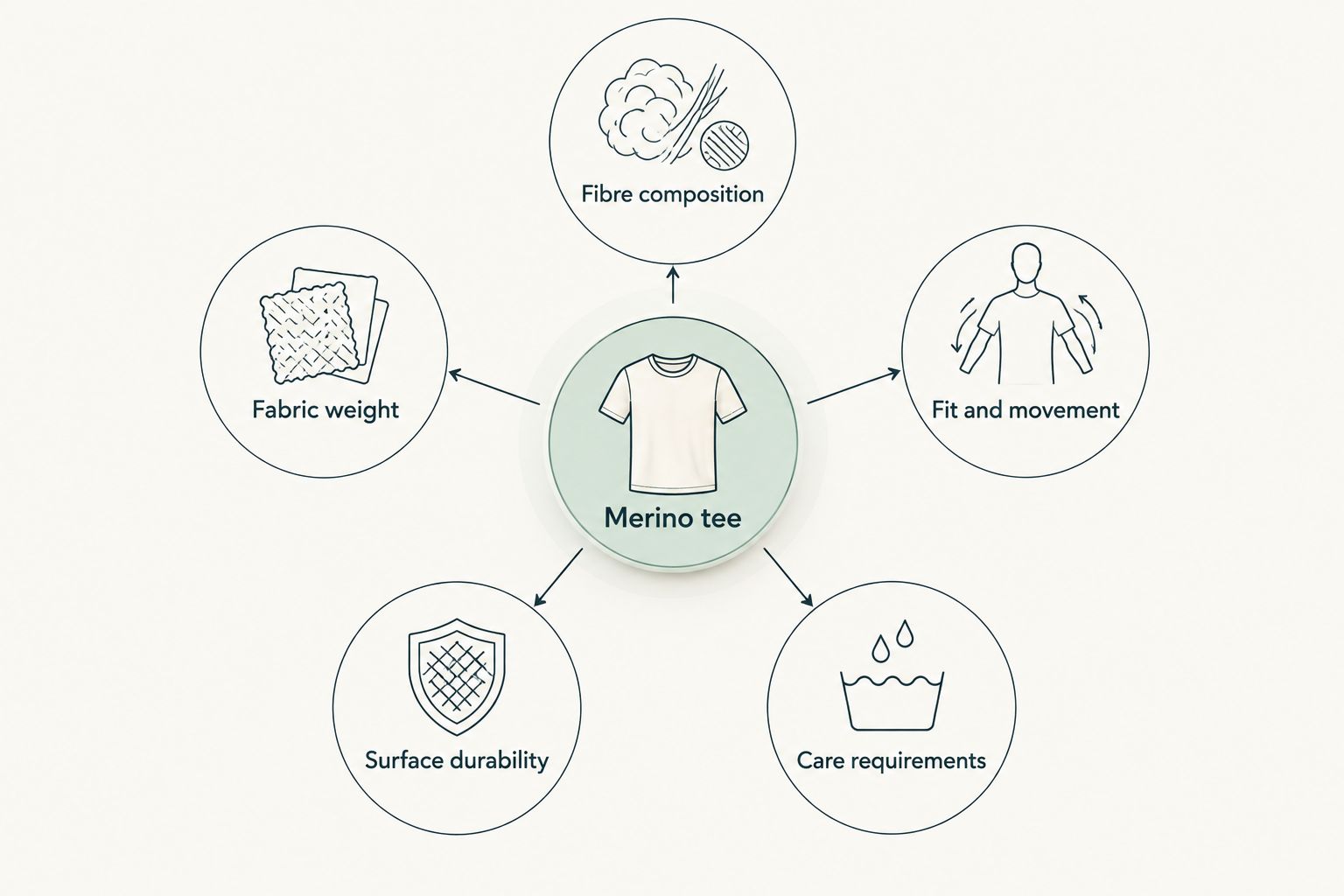
Use these criteria before looking at colours or styling photographs. Each answers a different question about how the tee will work in your wardrobe.
- Fibre composition: Read the complete fibre breakdown. Pure merino and a merino blend are not interchangeable descriptions.
- Fabric weight: Look for a stated weight in grams per square metre, written as gsm. Compare it alongside knit construction rather than treating it as a warmth guarantee.
- Fit and movement: Check chest room, shoulder placement and body length. A close base layer and a relaxed standalone tee need different fits.
- Surface durability: Consider contact with pack straps, belts and rough outer layers. Look for construction details rather than assuming every wool blend is tougher.
- Care requirements: Follow the garment label, including washing and drying instructions. Merino does not automatically mean machine-washable.
A useful 2026 shortlist puts these details ahead of broad claims such as travel-ready or all-season. If two tees have similar composition, their weight, dimensions and care instructions give you better grounds for choosing between them.
Men’s merino T-shirts at a glance
These are shopping categories, not named-product rankings. The order reflects a general everyday wardrobe first, followed by more specific requirements; an individual garment still needs to pass the checks above.
| Rank and option | Best for | Standout feature | Key limitation |
|---|---|---|---|
| Lightweight pure merino | Everyday standalone wear | An all-merino fabric without another fibre in the blend | Fine knits need care around abrasive surfaces |
| Reinforced merino blend | Walking with a backpack | Added reinforcement through fibre choice or construction | A blend label alone does not establish durability |
| Merino–lyocell blend | A softer, more fluid silhouette | Combines wool with a regenerated cellulose fibre | Drape and surface feel vary with the actual knit |
| Heavier merino tee | Cool-weather layering | More substantial fabric than a lightweight counterpart | Less suitable when you want the lightest layer |
1. Lightweight pure merino: best for everyday wear
A lightweight pure-merino tee is the starting point if you want a wool T-shirt to wear on its own. It keeps the material choice straightforward: a 100% merino composition means the stated fabric contains merino rather than a blend of different fibres.
Choose the fit as carefully as the fabric. A tee that pulls across your chest or hangs awkwardly at the hem will not become a better everyday garment because it contains wool.
Lightweight pure-merino pros:
- A clear choice when an all-merino composition is your priority.
- Works as a standalone tee or beneath an open shirt.
- Wool’s moisture absorption helps manage moisture vapour near the skin.
- Wool generally resists odour retention better than polyester, though wear conditions still matter.
Lightweight pure-merino cons:
- Fine knitted fabric needs protection from abrasion and snagging.
- A light-coloured, lightweight tee needs an opacity check.
- Care instructions still determine whether your usual laundry routine is suitable.
Best for: Everyday wear when you want merino itself, rather than a particular technical construction.
For your 2026 wardrobe, choose this category if most wear means commuting, desk work and casual outings. Check the tee in daylight, move your arms and sit down before deciding whether its fit works.
Verdict: Buy lightweight pure merino as the default, provided its fit and care requirements suit you.
2. Reinforced merino blend: best for carrying a backpack
A reinforced merino blend combines wool with another fibre or uses a reinforcing yarn construction. Nylon is one example of a fibre used in these blends, but the composition percentage alone does not describe how the fabric is built.
For pack-carrying use, examine the shoulders and the areas where straps contact the tee. Reinforcement is relevant here because those surfaces face repeated rubbing.
Reinforced merino-blend pros:
- Gives you a category specifically worth investigating for abrasion-heavy use.
- Retains merino within a fabric designed around mixed-fibre construction.
- Offers an alternative to choosing a delicate everyday knit for every activity.
Reinforced merino-blend cons:
- Added synthetic fibre does not prove that a particular tee lasts longer.
- Fabric construction, seams and fit still affect performance.
- It does not meet a preference for an entirely wool fabric.
Best for: Walks and travel days where you regularly carry a backpack.
Read the construction description closely. A meaningful explanation of reinforcement tells you more than a general durability claim, while smooth shoulder seams and comfortable movement matter during a fitting.
Avoid selecting an overly tight tee to stop fabric movement beneath straps. You still need room to reach forward and lift your arms without the shoulders binding.
Verdict: Buy a reinforced merino blend for pack use when the construction details support that purpose.
3. Merino–lyocell blend: best for a softer, fluid silhouette
A merino–lyocell tee combines wool with lyocell, a regenerated cellulose fibre. This category is worth considering when you want a fabric with a softer hand and flowing drape rather than a more structured T-shirt shape.
Handle the actual garment where possible. Blend proportions, yarn and knitting all affect the result, so the fibre names are a starting point rather than a promise of identical feel.
Merino–lyocell pros:
- Adds a different fabric option to an all-wool shortlist.
- Suits shoppers who prioritise drape over a firm silhouette.
- Works as a standalone casual layer when the cut and opacity are right.
Merino–lyocell cons:
- A fluid fabric will not suit everyone’s preferred shape.
- The blend name does not establish drying speed or abrasion resistance.
- Care requirements remain garment-specific.
Best for: Casual outfits where fabric feel and drape are your main priorities.
If you are shopping for warm days in 2026, compare this category with lightweight pure merino rather than assuming the blend will feel cooler. Fabric weight, air movement and how closely the tee sits against your body all matter.
Verdict: Buy a merino–lyocell blend for its feel and silhouette, not an unverified cooling claim.
4. Heavier merino tee: best for cool-weather layering
A heavier merino tee uses a more substantial fabric than a lightweight alternative. It belongs on your shortlist when the T-shirt’s main job is to sit beneath an overshirt, knit or jacket in cooler conditions.
Compare stated fabric weights where provided, but also check the knit and fit. More fabric weight is not a universal measure of warmth, and a bulky neckline can make layering uncomfortable.
Heavier merino-tee pros:
- Provides a more substantial option for a cool-weather outfit.
- Offers an alternative when lightweight tees feel too insubstantial.
- Works beneath outer layers when the shoulders and sleeves sit smoothly.
Heavier merino-tee cons:
- Adds more fabric than you need for a minimal warm-weather layer.
- A thick or tight neckline can interfere with an overshirt.
- It is not a substitute for weather protection or a complete winter layering system.
Best for: Cool-weather dressing with an overshirt or jacket.
Try the tee beneath the outer layer you actually wear. Check that the sleeves do not bunch, the hem stays where you want it and the collar sits cleanly.
Verdict: Buy a heavier merino tee for a defined layering role; skip it if your priority is minimal fabric.
How to check fit before you order
Start with a T-shirt you already like wearing. Lay it flat without stretching it, then record chest width, body length and sleeve length in centimetres so you have a practical reference for the retailer’s measurements.
Check whether the size chart gives body measurements or garment measurements. Chest circumference and a flat chest-width measurement are different quantities; compare like with like.
- Shoulders: Look for a seam position that matches the intended cut.
- Chest: Leave enough room to reach forward without pulling.
- Hem: Choose a length that works both standing and sitting.
- Sleeves: Check movement beneath your usual outer layer.
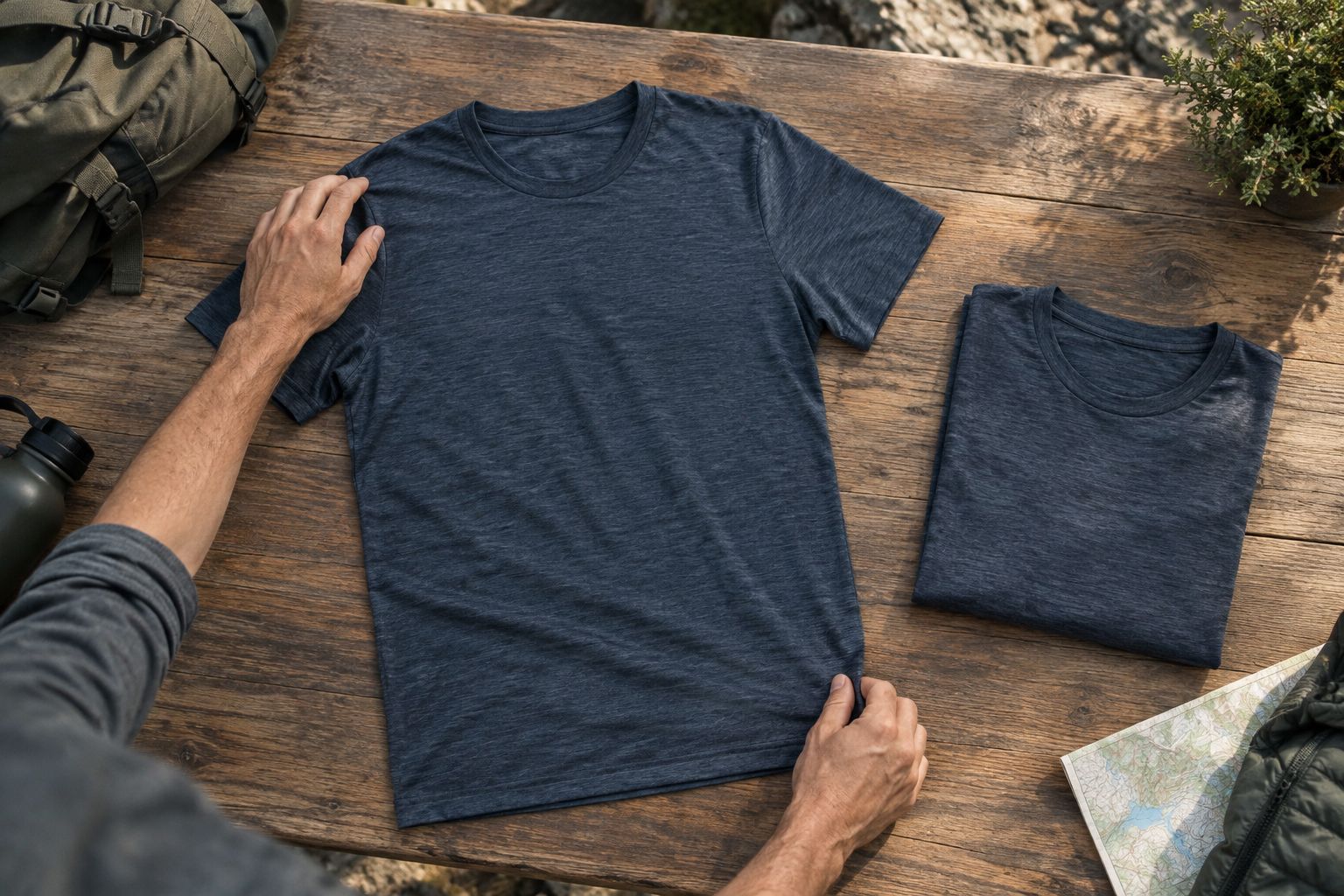
Do not size down simply because you expect wool to stretch. Buy the intended fit and follow the care label rather than trying to correct an unsuitable size through washing.
How the ranking works
This ranking prioritises everyday usefulness, then separates options by a distinct requirement: pack contact, drape or cool-weather layering. It compares fabric categories rather than claiming laboratory results or naming a single product as the Australian market winner.
For a 2026 purchase, use the ranking to narrow your search. Make the final decision from the individual garment’s composition, weight, measurements, construction and care label.
Where Blkwd fits in your T-shirt search
Blkwd is best for shoppers choosing everyday fashion T-shirts rather than selecting a tee solely for a merino specification. Its everyday options include PERCY - T-SHIRT in petrol and VERNON - T-SHIRT in black, both described for wearing alone or beneath an open shirt.
The distinction matters. Colour and styling descriptions help you build an outfit, but they do not establish wool content, fabric weight or technical performance.
Choose Blkwd when your brief is everyday casual clothing. When merino wool is non-negotiable, require an explicit merino composition before adding any garment to your shortlist.
Which men’s merino T-shirt should you choose?
Choose lightweight pure merino if you want a straightforward everyday starting point. Move to a reinforced merino blend for regular pack contact, a merino–lyocell blend for drape, or a heavier tee for cool-weather layering.
Do not buy several similar tees before resolving fit and care. A garment that works with your existing clothes and laundry routine is more useful than a theoretically ideal fabric you avoid wearing.
FAQ
What’s the best men’s merino wool T-shirt for everyday wear?
A lightweight pure-merino tee is the starting point for everyday wear. Choose the individual garment by its fit, opacity and care instructions rather than wool content alone.
Is 100% merino better than a merino blend?
Neither is better for every use. Pure merino suits an all-wool preference, while a reinforced blend deserves consideration when the tee will regularly contact backpack straps.
Can men wear merino T-shirts in an Australian summer?
Yes, a lightweight merino tee is an option for summer wear. Assess fabric weight, knit and fit; a heavier layering tee is a different choice despite sharing the same fibre.
Do merino T-shirts need washing after every wear?
Not automatically: wash according to soil, odour and the garment’s care instructions. Airing between wears does not replace washing when the tee is dirty.
Can I put a merino T-shirt in the washing machine?
Only machine-wash a merino T-shirt when its care label permits it. Follow the specified cycle, detergent and drying instructions rather than applying one routine to every wool garment.
Does Blkwd’s everyday T-shirt styling establish merino wool content?
No, styling descriptions do not establish fibre composition. For a merino-specific purchase, check that the individual garment explicitly states merino wool and its fibre breakdown.
One last thing
Fabric weight and fibre fineness describe different things. Grams per square metre describes fabric mass per area; microns describe fibre diameter. Neither measurement replaces a fit check, and a fine fibre does not automatically mean a lightweight garment.
Before buying, write down your main use in a short phrase: everyday wear, backpack walking, soft drape or winter layering. Choose the category that answers it, then inspect the garment details.