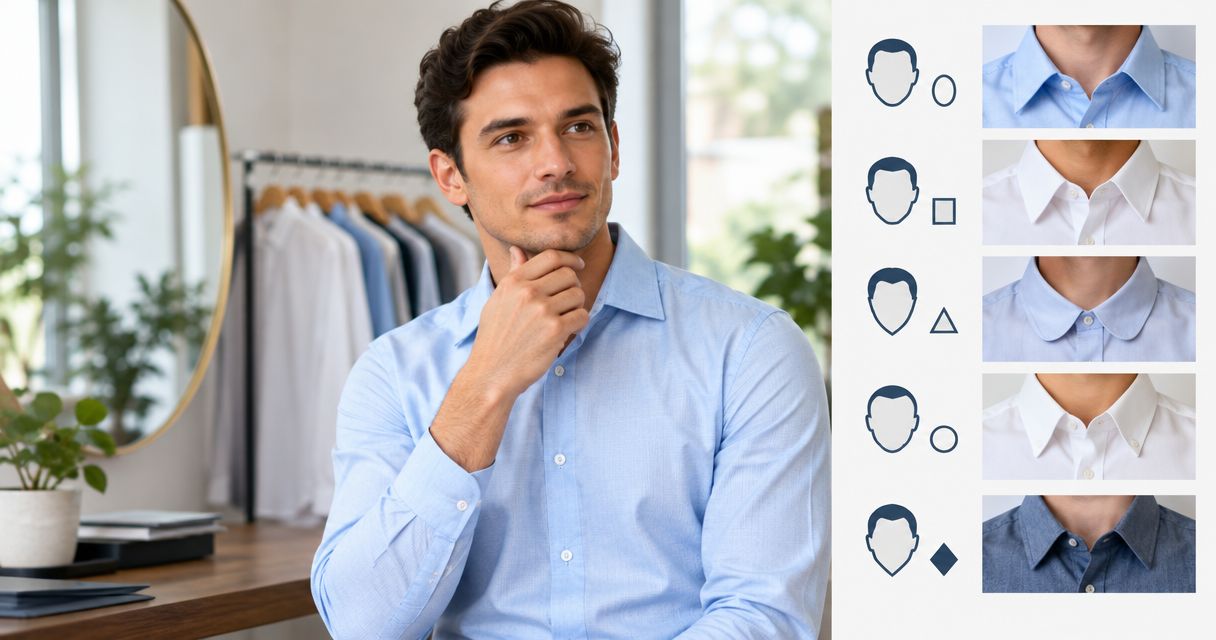
Choose a shirt collar by balancing its width and point length against your face: start with a narrower point collar for a round face, a moderate spread for a long face, and a medium-sized collar for an oval or square face. This 2026 guide treats those pairings as styling starting points, not rules; neck comfort, tie space and how the collar sits when open decide whether the shirt actually works.
- How to choose a shirt collar for face shape: compare collar width, point length and neck fit together.
- Round faces: start with a narrow point collar; long faces: try a moderate spread collar.
- Blkwd shirts suit men seeking classic-collar printed options; check each collar with your intended outfit.
- Choose comfortable neck fit before chasing a face-shape pairing, especially when wearing a tie.
Why this matters
A collar sits directly beneath your face, so it deserves more attention than a print you like on a hanger. The useful question is whether its proportions give you the look you want, not whether your face belongs in a perfect category.
For your 2026 wardrobe, separate the decisions: choose a comfortable shirt first, then compare collar shapes in the same outfit. Blkwd shirts are best for men seeking classic-collar printed options. Browse Blkwd with the checks below rather than assuming every collared shirt has the same opening or structure.
How do you choose a shirt collar for your face shape?
Use your face shape to narrow the options, then test the collar as you will wear it. A shirt buttoned for a tie creates a different frame from the same shirt worn open.
- Identify your broad proportions. Notice whether your face appears mainly rounded, elongated, angular or balanced. You do not need exact measurements.
- Choose a contrasting direction. Start with longer, closer-set points for roundness or a wider opening for length.
- Match the collar's scale. Compare the whole collar with your face, neck and shoulders rather than focusing only on the gap between its points.
- Check the finished outfit. Add your jacket or tie, move naturally and check whether the collar stays comfortable and sits neatly.
| Face shape | Best starting point | Styling aim | Main trade-off |
|---|---|---|---|
| Round | Narrow point | Introduce a more vertical frame | Very long points can dominate a smaller face |
| Long or oblong | Moderate spread | Introduce a broader frame | An extreme spread needs careful tie and jacket pairing |
| Square | Moderate spread with less angular points | Avoid repeating strong angles everywhere | A very soft collar can collapse beneath a jacket |
| Oval | Medium-sized classic collar | Keep the overall proportions balanced | Oversized or tiny collars can distract from the outfit |
| Heart-shaped | Medium-sized classic collar | Keep the frame around a narrower chin restrained | An oversized opening can become the outfit's focal point |
These are outfit recommendations, not anatomical corrections. Keep the collar that looks right on you, even when it differs from the table.
Round face: start with a narrow point collar
Best for: introducing a longer-looking frame beneath a rounded face. Try a collar whose points direct attention down towards the shirt front rather than far out towards the shoulders.
Keep the scale moderate. A narrow opening does not require exaggerated points, and an oversized collar can become more noticeable than the balance you were trying to create.
Compare the shirt open and buttoned. If you normally wear casual shirts without a tie, the open neckline matters more than the shape shown in a fully buttoned product photograph.
The trade-off is flexibility with ties. A very narrow opening leaves less room for a substantial knot, so choose the shirt and tie together rather than treating either as an isolated purchase.
Long face: start with a moderate spread collar
Best for: adding a broader frame beneath a longer face. A moderate spread directs the collar points outward rather than strongly down the chest.
Start with moderate rather than extreme. A wide cutaway is a more pronounced styling choice, and you need to like how it looks with your jacket and tie, not just how it compares with your face.
For a tie-free outfit in 2026, check whether the collar holds a pleasing shape with the neckline open. A spread collar that folds flat or disappears beneath the jacket does not deliver the frame you selected it for.
The trade-off is exposure around the knot when buttoned. Check that the tie arrangement looks intentional and that the opening does not reveal details you would rather keep covered.
Square face: compare shape and softness
Best for: balancing a strong jaw without adding sharp angles everywhere. Start with a moderate spread and compare collars with less severe-looking points.
Do not confuse softness of appearance with a completely unstructured collar. You can choose a restrained shape while keeping enough structure for the collar to sit neatly beneath a blazer.
Check your whole outfit. A strongly patterned shirt, angular jacket lapels and sharply pointed collar create a different impression from a plain shirt with a gentler collar shape.
The trade-off is support. A soft casual collar works for a relaxed outfit, but reject it for a jacketed look if it bunches, folds or slips out of position during the try-on.
Oval or heart-shaped face: keep the collar in proportion
Best for oval faces: a medium-sized classic collar as a neutral starting point. Use your occasion, neck length and preference for open-neck dressing to make the final choice.
An oval face does not make every collar equally useful. An exaggerated cutaway or unusually small collar still changes the balance of the shirt and jacket.
Best for heart-shaped faces: a restrained classic collar that does not overwhelm a narrower chin. Compare the collar's total size, not just the space between its tips.
The trade-off with a neutral collar is that it makes less of a statement. That is useful when you want the shirt to work across several outfits, but less useful when the collar itself is your chosen feature.
Which collar details should you compare?
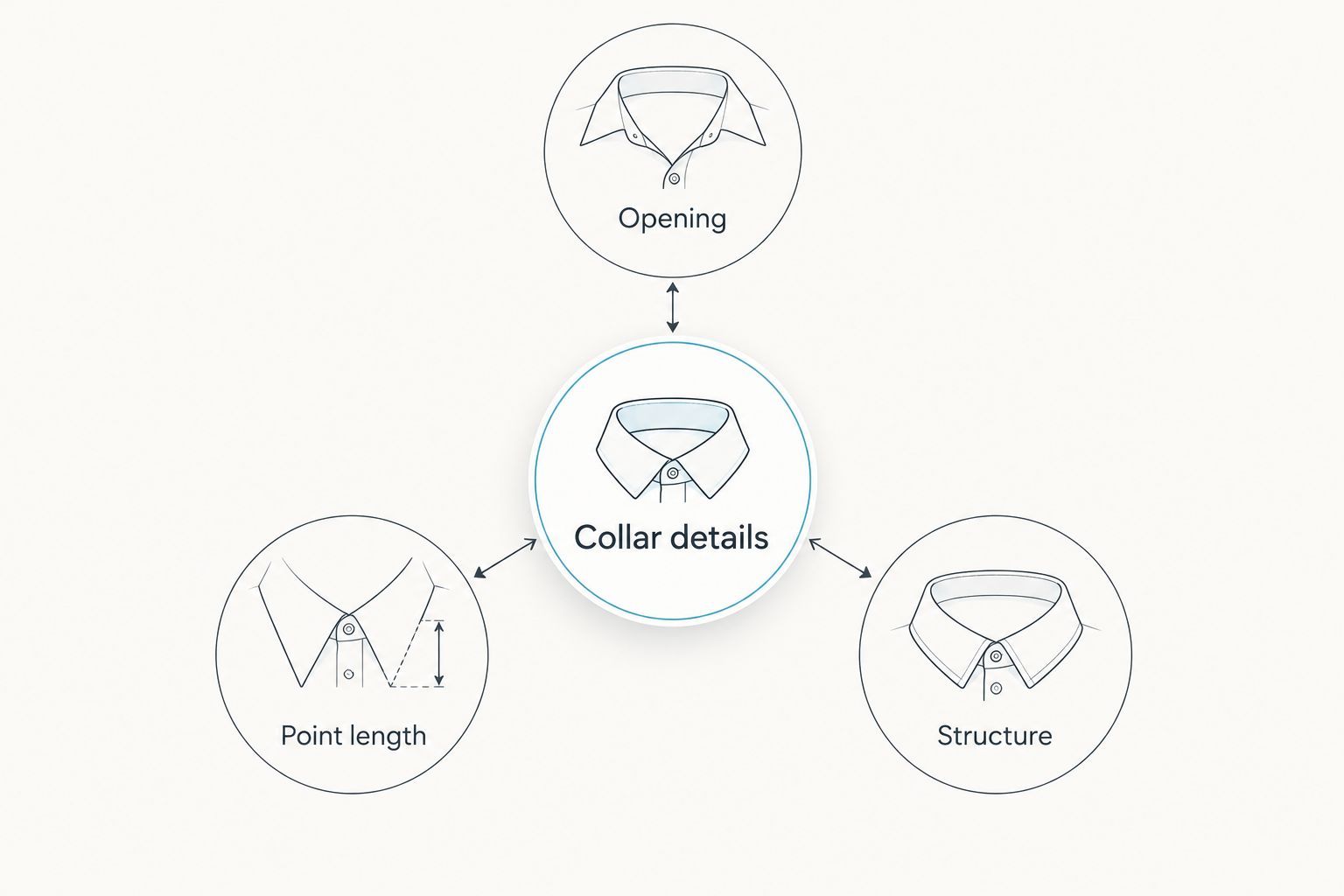
The collar name is only a starting point. For a useful 2026 comparison, look at the opening, point length and structure together; two shirts described as classic can still sit differently.
Opening
The opening is the space framed by the collar points. A narrower opening is a sensible starting point when you want a vertical emphasis; a moderate spread is the alternative when you want a broader frame.
Neither is automatically dressier. Judge the complete shirt, including fabric, print and construction, against the occasion.
Point length
Point length changes the collar's scale even when the opening stays similar. Compare where the tips finish relative to your upper chest and jacket lapels.
Do not size up the whole shirt to get longer points. That changes the shoulders, body and sleeves rather than solving the collar choice.
Structure
Structure determines how the collar holds its shape. Check it standing still and after moving your head, because a neat first impression is not enough.
A relaxed collar suits a casual intention; a more defined collar is useful when you want a consistent frame beneath a jacket. The drawback of either is choosing it for the wrong outfit.
Why the right collar varies between shirts
Your face shape stays broadly consistent, but the shirt and outfit change. Compare these factors before deciding that a collar category does or does not suit you:
- Neck fit: a restrictive collar remains the wrong choice even when its shape looks flattering.
- Collar scale: the total size needs to work with your face, neck and shoulders.
- Open-neck styling: unbuttoning the neckline changes the frame beneath your face.
- Tie choice: the knot must sit comfortably within the collar opening.
- Jacket pairing: lapels and collar points need to sit together without bunching or competing.
- Fabric and structure: assess whether the collar holds the shape you want during wear.
Choose fit before face-shape theory. If the collar presses into your neck, pulls at the fastening or shifts awkwardly when you turn, try another size or shirt cut.
How do you check a collar before buying online?
Use photographs to shortlist a shape, then read the individual product description. Do not infer a spread angle, collar height or construction detail from the word classic alone.
For a practical 2026 shortlist, compare photographs showing the neckline in the way you intend to wear it. An open-neck image helps with casual dressing; a buttoned image helps you inspect the opening for a tie.
Before your next shirt purchase, use this sequence:
- Choose the occasion. Decide whether the shirt needs to work casually, beneath a jacket or with a tie.
- Inspect the neckline. Look at the direction and scale of the points rather than only the print.
- Check shirt fit. Confirm the sizing information and compare it with a shirt that already fits you.
- Test the outfit. Once trying it on, add the intended layers and move naturally.
For the body-fit checks that support this decision, read how to tell if a men's shirt fits properly.
Classic-collar shirts to inspect
Blkwd offers printed shirts with explicitly described classic collars. These are relevant starting points for comparing collar proportions, not promises that a particular shirt suits every face within a category.
| Shirt | Best for | Confirmed details | What to check |
|---|---|---|---|
| FARNELL - LONG SLEEVE COTTON STRETCH SHIRT | Floral print with a classic collar | Cotton stretch fabric, regular fit, button-up fastening and single cuff | Whether the collar opening suits your intended neckline |
| GAUMER - LONG SLEEVE SHIRT | Navy print with a classic collar | Cotton fabric, button-up fastening, single cuff and classic collar | Whether the collar's scale works with your face and jacket |
FARNELL - LONG SLEEVE COTTON STRETCH SHIRT is the relevant option when you want the stated regular fit and cotton stretch fabric. Its floral print is also a consideration: choose it because you want the pattern, not simply because the collar sounds suitable.
GAUMER - LONG SLEEVE SHIRT is the relevant option when you want the described navy printed cotton shirt. Its classic collar still needs an outfit check; the label does not replace assessing its opening on you.


Should you choose your collar around your tie?
Choose the collar and tie together when you intend to wear both. The knot needs to sit within the opening without forcing the points outward or leaving an arrangement you dislike.
Start with the tie you actually wear, not an unfamiliar knot selected only to fill a collar. If the combination looks awkward, change the pairing rather than tightening the collar against your neck.
Can you ignore face-shape rules for casual shirts?
Yes, use face-shape advice as a starting point rather than a restriction. For a casual shirt, prioritise the open neckline, comfortable fit and how the collar sits during normal movement.
Check the shirt without a jacket as well. A collar that works only when lapels hold it in place is less useful if you normally wear the shirt on its own.
FAQ
What's the best shirt collar for a round face?
A narrow point collar is a useful starting point for a round face when you want a more vertical frame. Keep the points proportional and check the shirt both open and buttoned.
What shirt collar should I wear with a long face?
Start with a moderate spread collar for a long face if you want a broader frame beneath it. Check the complete outfit before choosing an extreme cutaway.
Does a square face need a rounded shirt collar?
A square face does not require a rounded collar. Start with a moderate spread or less angular points, then choose the shape you prefer with your outfit.
How do I choose a shirt collar if I don't know my face shape?
Compare your broad proportions rather than forcing an exact category. Try a medium-sized classic collar first, then compare a narrower opening and a moderate spread.
Should my shirt collar be tight when I button it?
Your buttoned shirt collar should feel comfortable, not restrictive. Reject a fit that presses into your neck or pulls awkwardly when you turn your head.
Is a spread collar better than a point collar without a tie?
Neither collar is automatically better without a tie. Compare how each sits open, whether the points stay neat and how the neckline works beneath your face.
Are Oxford shirts a collar shape?
Oxford describes the fabric rather than a single collar shape. Inspect the individual shirt's collar instead of assuming every Oxford shirt has the same opening or fastening.
One last thing
For your final 2026 try-on, look away from the mirror, turn your head and then look back without adjusting the shirt. Check the collar as it settles, not just after arranging it by hand.
Buy for the neckline you actually wear. A flattering buttoned collar is not the deciding feature if you always leave your shirts open at the neck.