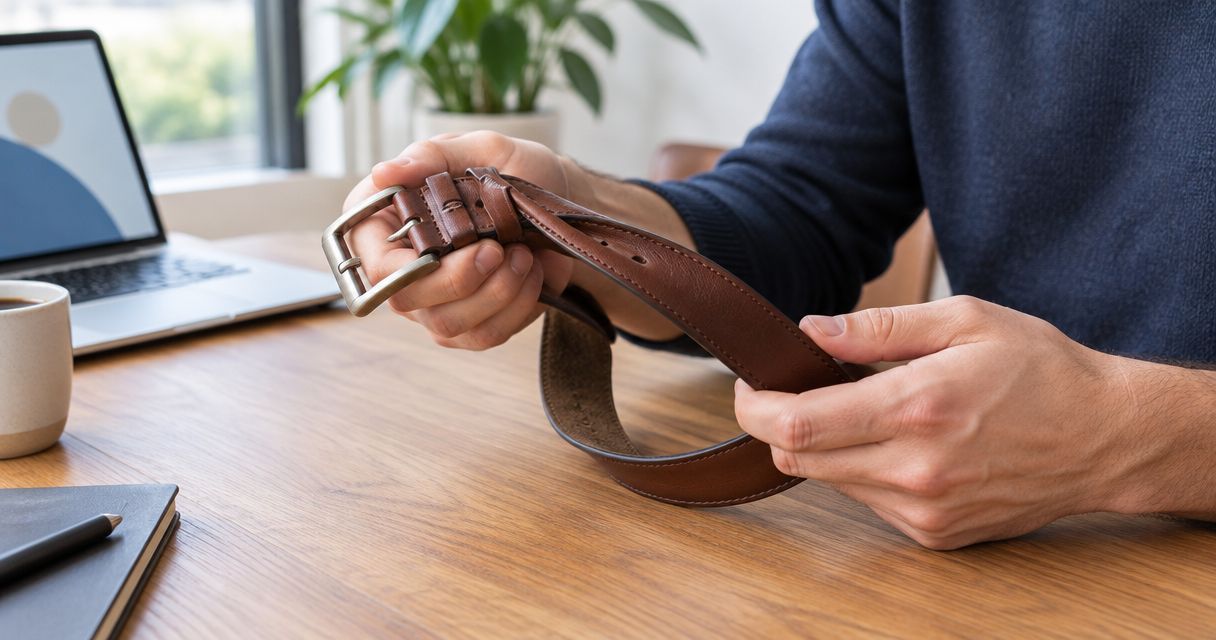
A new leather belt breaks in gradually through repeated, comfortable wear; there is no universal number of days that applies to every belt. For your 2026 wardrobe, judge progress by easier bending and comfortable fastening—not by stretching the belt until a tight size fits.
- How long to break in a leather belt depends on its construction, finish and how you wear it.
- Gentle wear is the starting point; forced stretching is not a fix for the wrong size.
- Stop if you see cracking, peeling, loose stitching or distortion around the buckle holes.
- Blkwd sells reversible men's belts; check each belt's material and care instructions before treating it as leather.
If you are choosing accessories alongside clothing, Blkwd sells men's belts as well as shirts, denim and pants. The care advice below concerns leather belts: do not apply it automatically to coated, synthetic or mixed-material straps.
Why this matters
Breaking in a belt should improve flexibility, not rescue an uncomfortable fit. A firm new strap and a belt that digs into your waist are different problems, even when both feel stiff at first.
The distinction matters because aggressive softening methods can damage a finish, distort the strap or weaken its construction. Start with fit, then give the belt normal movement rather than trying to force a result before an event.
How long does it take to break in a new leather belt?
There is no single break-in deadline for a leather belt. Leather thickness, tanning, surface treatments, backing and reinforcement all affect how a finished strap bends, so a calendar alone cannot tell you whether yours is progressing normally.
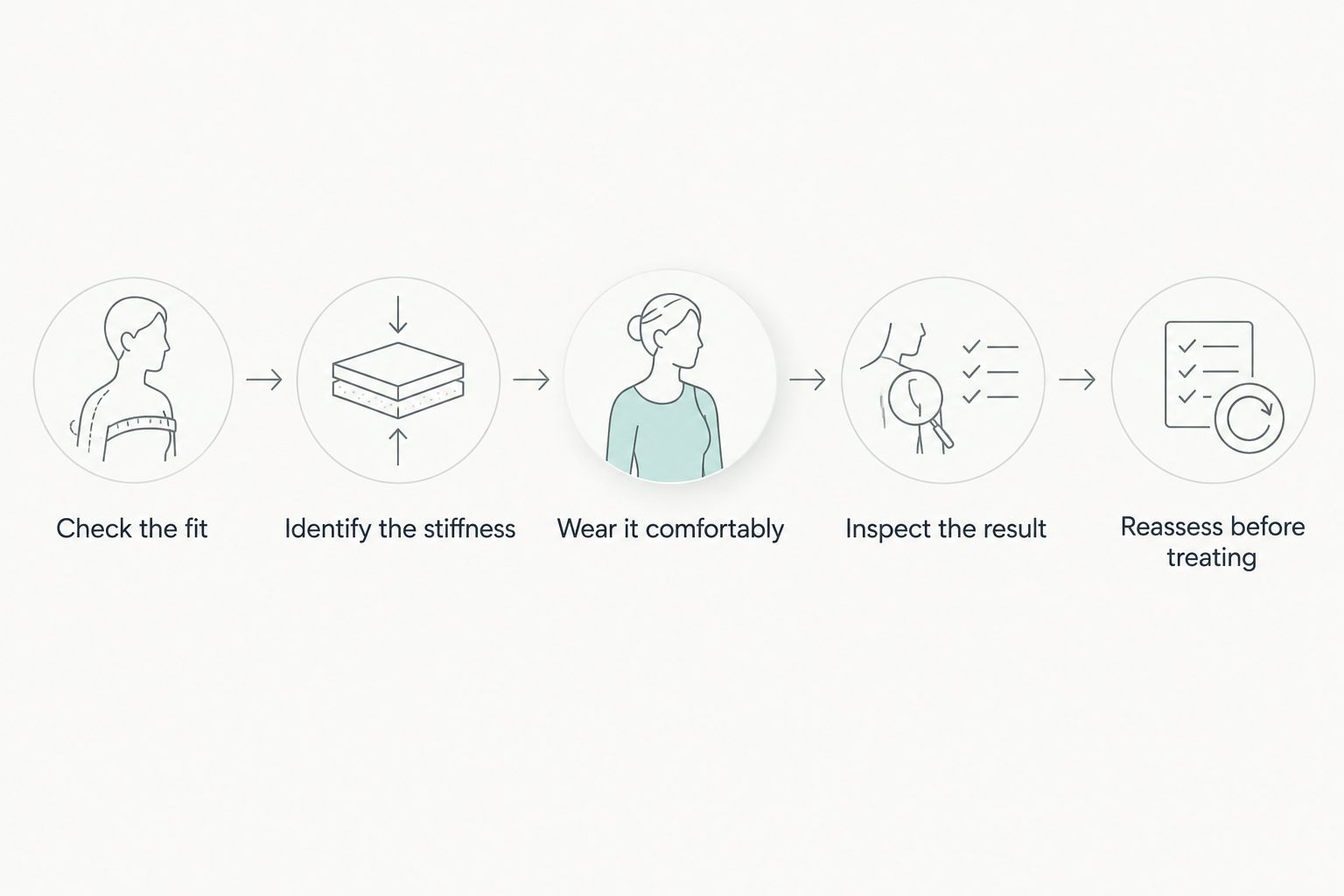
Use this sequence to assess the belt instead:
- Check the fit. Fasten the belt without pulling hard, then sit down and stand up. It should hold your trousers without pinching.
- Identify the stiffness. Notice whether the strap feels firm throughout or whether a buckle edge, seam or isolated spot causes discomfort.
- Wear it comfortably. Use the belt normally, removing it if it rubs or presses painfully.
- Inspect the result. Look for easier curvature without cracks, peeling, loose stitching or stretched holes.
- Reassess before treating it. Follow the manufacturer's care instructions before applying any conditioner or cleaner.
A belt that becomes easier to thread and follows your waist more naturally is showing useful change. A belt that only becomes tolerable when you pull harder is not.
What does a successfully broken-in belt feel like?
A comfortably worn-in leather belt bends around your waist without requiring a sharp fold. You can fasten it normally, sit down and move without the strap creating persistent pressure.
Some firmness can remain, especially in a structured belt. Softness is not the goal at any cost: a belt still needs enough structure to hold its shape and support your trousers.
What is not normal break-in?
Pain, surface splitting and an increasingly distorted buckle hole are not signs to keep pushing through. Remove the belt and check the size, construction and care instructions before wearing it again.
A changing surface also needs interpretation. Gentle creasing at a flex point differs from a finish that lifts or exposes damaged material underneath; do not assume every visible change is harmless ageing.
Why leather belt break-in varies
The useful question is not just how long you have owned the belt. It is what the strap is made from and how it moves during wear.
- Thickness: a thicker strap generally resists bending more than a comparable thinner strap.
- Construction: linings, reinforcement and layered materials affect flexibility independently of the outer surface.
- Tanning and finish: leather treatments influence its feel and determine which care products are appropriate.
- Wear pattern: occasional use gives the strap fewer opportunities to flex than regular use.
- Fit and position: a belt worn too tightly creates pressure that softening alone does not solve.
- Condition: dry, damaged or deteriorating material needs assessment, not increasingly forceful bending.
For a belt you buy in 2026, read the material description before choosing a care method. A leather-looking surface does not establish what the strap, backing or coating contains.
Should you keep wearing it or change your approach?
Use the symptom to choose your next move. This comparison separates ordinary firmness from problems that deserve a pause.
| What you notice | Best for | What to do | Limitation or warning |
|---|---|---|---|
| Firm strap, comfortable fastening, no visible damage | Gentle normal wear | Wear it without overtightening and inspect flex points | Progress is gradual, not guaranteed by a deadline |
| Pinching when you sit down | A fit check | Loosen the fastening and reassess the size | Softer leather will not reliably correct insufficient length |
| Dry-looking surface without obvious structural damage | Manufacturer-approved care | Check whether the maker recommends a suitable conditioner | The wrong treatment can alter colour or finish |
| Cracks, peeling, loose stitching or elongated holes | Stopping wear | Assess the damage and seek product-specific advice | Continued bending can worsen an existing fault |
Choose comfortable wear over forced softening. It lets you assess how the belt behaves without committing to an irreversible treatment.
Do not turn that recommendation into an endurance test. If you keep adjusting the belt because it hurts, stop and investigate the fit rather than waiting for the leather to surrender.
How do you break in a leather belt without damaging it?
Start with trousers that fit
Wear the belt with trousers that already sit reasonably at your waist. A belt should not need to gather large amounts of excess fabric to keep them up.
Check comfort while seated as well as standing. If changing your posture makes the buckle or strap dig in, try a different fastening position before blaming the material.
Let the strap bend naturally
Thread the belt through the loops and fasten it without yanking the free end. Let ordinary movement introduce a gradual curve rather than bending the strap sharply backwards.
The advantage is control: you can stop when discomfort appears. The drawback is that normal wear does not offer an instant transformation, particularly when the belt's construction is deliberately firm.
Remove it carefully
Unfasten the buckle fully before pulling the strap back through. Avoid dragging the buckle tongue along the surface or forcing a bulky end through a tight loop.
Watch the buckle attachment and fastening holes during removal. These areas experience repeated handling, so changes there deserve attention before the rest of the strap looks worn.
Store it without a sharp fold
Let the belt rest in a relaxed shape, away from direct heat. Avoid crushing it beneath other items or folding it tightly at the same point each time.
Storage does not replace wearing the belt, but it avoids adding an unnecessary crease. Follow any specific storage instructions supplied with the product.
Can conditioner make a new leather belt softer?
Conditioner is a care product, not a universal break-in shortcut. Use it only when it suits the leather and finish and the manufacturer's instructions permit it.
For your 2026 care routine, check the label rather than choosing a household substitute. Test an approved product on an inconspicuous area first because treatment can change appearance, including colour and sheen.
Do not condition a belt simply because it is new and firm. If the strap is already in good condition, extra treatment is not automatically useful; fit and construction still determine how it feels.
Why not use cooking oil or heavy household products?
Household oils are not interchangeable with leather-care products. They can leave unwanted residue or alter the surface, and they do not come with instructions matched to your belt's finish.
The supposed advantage is convenience. The disadvantage is losing control over the result, especially on a light-coloured, coated or reversible strap.
Can you speed up break-in with water, heat or stretching?
Skip deliberate soaking, direct heat and forceful stretching. They introduce damage risks without giving you a dependable, product-specific break-in result.
Do not put the belt in a washing machine, heat it with a hairdryer or leave it against a heater to make it pliable. If it gets wet accidentally, follow its care instructions and let it dry away from direct heat.
Pulling hard on the strap also concentrates force around holes and hardware. An enlarged hole is wear damage, not evidence that the belt now fits correctly.
For a 2026 event, wear a belt you already find comfortable rather than experimenting with treatments immediately beforehand. That is a wardrobe decision, not a leather-softening technique.
Is a stiff leather belt the wrong size?
A stiff belt is not automatically the wrong size, but persistent tightness requires a fit check. Loosen it and compare comfort while standing, sitting and bending normally.
If loosening solves the pressure but leaves an unsuitable fastening position or insufficient usable length, reassess the size. Do not count on future stretching to provide the length you need.
Buckle shape matters too. Localised pressure directly beneath the hardware calls for a different assessment from a strap that feels uniformly firm.
What should you check when buying a replacement belt?
Choose by material, fastening, width and fit before thinking about break-in. For a broader comparison, see the guide to men's belts in Australia.
Blkwd is best for men comparing reversible belts alongside everyday clothing. Its LUCAS - MENS BELT and FREDRICK - MENS BELT descriptions specify reversible designs with pin buckles; verify their material and care information before applying leather-specific advice.
| Belt | Best for | Stated feature | What to check before choosing |
|---|---|---|---|
| LUCAS - MENS BELT | A reversible pin-buckle option | Reversible design and pin buckle | Material, width, sizing and care instructions |
| FREDRICK - MENS BELT | An alternative reversible pin-buckle option | Reversible design and pin buckle | Material, width, sizing and care instructions |
Both options offer reversibility, but that feature alone does not establish leather composition or predict softness. Choose between them using the product details and your fit requirements—not an assumed break-in time.


FAQ
How long to break in a leather belt if I wear it every day?
Daily wear does not establish a universal break-in deadline. Judge progress by comfortable fastening, easier bending and an undamaged surface rather than a fixed day count.
Should a new leather belt hurt when I sit down?
A new leather belt should not cause persistent pain when you sit down. Loosen it and check the size, buckle position and trouser fit before wearing it again.
Will a leather belt stretch enough if I buy it too small?
Do not buy a belt that depends on stretching to fit. Choose a size that fastens comfortably from the start rather than forcing the strap or fastening holes.
Can I soften a leather belt with conditioner?
Use conditioner only when the belt's manufacturer permits a product suitable for its leather and finish. Test it discreetly first, because treatment can change colour or appearance.
Can I use a hairdryer to break in a leather belt?
Do not use a hairdryer to break in a leather belt. Keep it away from direct heat and use comfortable normal wear instead.
Is creasing the same as cracking on a leather belt?
Creasing and cracking are different: a flex crease is not the same as a split or lifting finish. Stop forceful bending if you see splitting, peeling or exposed damaged material.
Are Blkwd reversible belts necessarily leather?
Reversibility does not establish a belt's material. Check the individual product's material and care details before using leather conditioner or other leather-specific treatments.
One last thing
Before replacing a stiff belt in 2026, try it with another pair of well-fitting trousers. Different waistband positions and belt loops change where the strap and buckle sit, helping you distinguish a belt problem from a clothing-fit problem.
Then make the decision simple: keep wearing a comfortable, undamaged belt gently; reassess one that pinches or deteriorates. A usable belt is the goal—not the softest possible strap.