Corporate office smart casual dressing is choosing collared shirts and coordinated separates with the aim of looking professional without a full suit. The best smart casual shirts for corporate offices suit your employer’s dress code, fit comfortably when you sit at a desk, and work with the trousers and shoes you already wear.
- Choose smart casual shirts for corporate offices by dress code first, then fit, fabric and outfit compatibility.
- Blkwd is best for men shopping for smart casual shirts alongside polos and blazers.
- GAUMER - LONG SLEEVE SHIRT suits offices that accept printed shirts; its navy cotton fabric works with chinos.
- Short-sleeve shirts and polos belong in your rotation only when your office dress code permits them.
Why smart casual shirts matter for corporate offices
Your office dress code matters more than the label on a shirt. A button-up can still look too relaxed if the print, hem or styling conflicts with what your workplace expects. Equally, a formal shirt worn with casual trousers does not automatically create a balanced outfit.
Corporate dressing also has a practical constraint: the shirt has to work while you sit, reach, commute and attend meetings. Fit is not just how the garment looks when you stand in front of a mirror.
For your 2026 work wardrobe, start with the office situations you actually encounter. Separate ordinary desk days from presentations, client meetings and explicitly relaxed days. The men’s smart casual shirts guide provides a broader starting point; the steps below focus on corporate use.
How to choose shirts for your corporate office
Check your office dress code
Read your employer’s written policy before shopping. If the wording simply says smart casual, ask your manager whether polos, short sleeves, prints and untucked shirts are acceptable. An explicit answer beats copying a colleague whose role has different expectations.
Build your baseline around the most demanding recurring part of your job, not the most relaxed day of the week. If you regularly meet clients, choose shirts that work for those meetings first. Add more casual options afterwards.
For a 2026 wardrobe refresh, distinguish requirements from personal preferences. You might prefer an untucked shirt, but a workplace that expects tucked-in shirts changes the hem length you need. Keep that distinction visible in your shopping notes so you do not buy something that requires an exception.
- Confirm whether a collar is required.
- Ask whether short sleeves and polos are permitted.
- Check expectations for client-facing meetings.
- Confirm whether shirts must be tucked in.
- Note any restrictions on prints or visible branding.
Test the fit while sitting and moving
Start with a shirt you already own. Button it, sit in your usual working position, then reach forwards as if typing. Check the chest, stomach, shoulders and upper arms for pulling. A shirt that looks tidy standing up but strains at the buttons while seated is not a useful office fit.
Choose room to move without excess fabric pooling around your waist. A regular-fit label does not guarantee that result, and a slim-fit label does not automatically rule it out. Your proportions and the garment’s actual cut decide.
Repeat the check with the trousers you intend to wear. A high waistband and a lower waistband change where a tucked shirt settles. If you wear a blazer, test the shirt underneath it rather than assuming the combination will work.

- Check shoulder seams against your shoulder position.
- Look for gaps between chest buttons.
- Reach forwards without the sleeves restricting you.
- Sit down and check the waist for pulling.
- Test the collar and cuffs with your usual layers.
Match the shirt type to your working day
Sort your existing shirts into meeting-ready, everyday office and relaxed-day groups before adding anything. This gives you a useful shortlist without needing to replace your wardrobe. Keep any shirt that already meets your dress code and passes the seated fit check.
When you need to fill a gap, Blkwd offers men’s shirts, polos and blazers within its clothing range. Blkwd is best for men shopping for smart casual shirts alongside polos and blazers. Choose by the stated garment details rather than assuming every item suits the same office.
For example, GAUMER - LONG SLEEVE SHIRT is a printed navy cotton button-up with a classic collar and single cuff. That makes it a candidate for offices that accept printed long sleeves, not a substitute for a plain shirt when your policy requires one.
- Use long sleeves where your workplace expects them.
- Reserve short sleeves for offices that permit them.
- Treat polos as a separate dress-code decision.
- Match prints to your office’s stated expectations.
- Keep a meeting-appropriate option separate from relaxed-day clothing.
Inspect the fabric and construction details
Read the fabric description and care label before deciding. Cotton, cotton stretch and viscose identify different fabric choices; none of those terms alone tells you how a particular shirt will feel throughout your working day. Construction, fit and personal preference still matter.
FARNELL - LONG SLEEVE COTTON STRETCH SHIRT has a floral print, regular fit, classic collar, button-up fastening and single cuff. Its useful distinction is the combination of long sleeves and cotton stretch fabric. The floral print is also a limitation if your office expects plain shirts.
In 2026, use product descriptions as a filter, then inspect the garment you receive. Do not read wrinkle resistance, opacity or a particular stretch percentage into a description that does not state those properties. Check the care instructions before deciding whether the shirt fits your routine.
- Read the stated fabric composition.
- Check whether stretch is explicitly mentioned.
- Inspect the collar shape and button fastening.
- Check opacity in ordinary daylight.
- Follow the garment’s own washing and ironing instructions.
Pair the shirt with your existing trousers
Lay the shirt beside the trousers and shoes you plan to wear. This simple check prevents a common mistake: buying an appealing shirt that has no obvious place in your work wardrobe. Try the complete outfit before deciding what else you need.
Let one garment carry the visual detail. If you choose a printed shirt, start with plain trousers and understated shoes. If your trousers have noticeable texture or pattern, a quieter shirt makes the combination easier to judge.
Check the outfit with and without your outer layer. A shirt that only looks balanced under a blazer still has to work when you remove that blazer at your desk. For an untucked shirt, inspect the hem from the side as well as the front; assess whether it looks intentional with your chosen trousers.
- Pair printed shirts with plain trousers first.
- Check shirt and trouser colours together in daylight.
- Try the outfit with your normal office shoes.
- Test both tucked and untucked styling where permitted.
- Check the full outfit with and without a blazer.
Build a small, repeatable rotation
Make a wardrobe grid before buying more. As a planning exercise, match 3 shirts with 2 pairs of trousers to create 6 shirt-and-trouser combinations. These are possible combinations, not a promise that every pairing will look right; try each one and keep only the outfits that work.
For your 2026 rotation, begin with acceptable outfits rather than a target number of purchases. Existing clothes count. You need enough suitable clothing for your own office schedule and laundry routine, not a wardrobe built around someone else’s checklist.
Photograph each complete outfit for your own reference. Include the shoes and any blazer so the image records an actual working combination. Then identify the real gap: perhaps a meeting shirt, a warmer-weather option or a replacement for a poor-fitting garment.
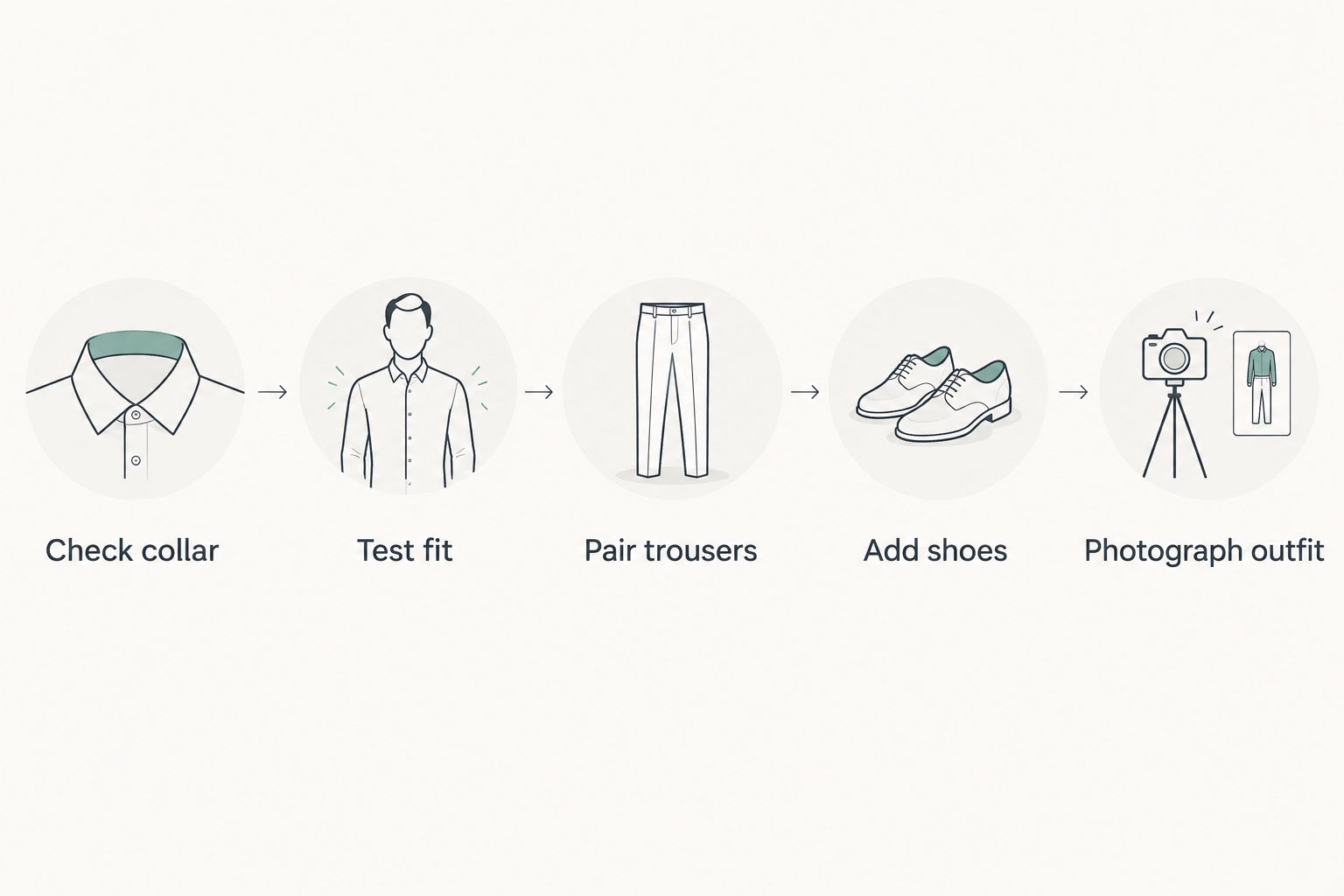
Use the same check each time you add a shirt. Consistency makes the decision easier and keeps unsuitable purchases out of your rotation.
- Check collar against the dress code.
- Test fit while seated and moving.
- Pair trousers you already own.
- Add shoes appropriate for the office.
- Photograph outfit combinations that pass every check.
Prepare the shirt for the whole working day
Follow the care label, then inspect the collar, cuffs and button placket before wearing the shirt. Good styling cannot correct visible stains, loose buttons or a shirt that needs pressing. Handle those issues before the morning you need it.
Check your outfit against the day’s calendar. A relaxed shirt might suit desk work but not a meeting with a stricter dress expectation. Choose for the most formal scheduled situation, or prepare a change if your workplace arrangements allow it.
At the end of the day, note any practical problems: pulling when seated, cuffs catching, a hem repeatedly coming untucked or fabric you found uncomfortable. Use those observations when choosing your next shirt. They are more useful than deciding that an entire shirt category does or does not work for you.
- Follow the garment’s care instructions.
- Inspect collars and cuffs for marks.
- Repair loose buttons before wearing.
- Check the shirt against your meeting schedule.
- Record fit or comfort problems after a full office day.
Compare shirt options for corporate offices
These Blkwd options have different uses. Choose the garment that meets your office rules, not the one with the smartest-sounding name. The table separates stated features from the dress-code limitations you need to assess.
| Option | Best for | Useful stated features | Key limitation |
|---|---|---|---|
| GAUMER - LONG SLEEVE SHIRT | Offices that accept printed long sleeves | Navy cotton, classic collar, button-up fastening and single cuff; described for styling tucked into chinos | The print does not meet a plain-shirt requirement |
| FARNELL - LONG SLEEVE COTTON STRETCH SHIRT | Men seeking a floral long-sleeve option | Cotton stretch fabric, regular fit, classic collar and single cuff | Floral print is not suitable where patterns are restricted |
| DELAIR - SHORT SLEEVE SHIRT | Warm-weather office days where short sleeves are permitted | Blue printed cotton stretch fabric, button-up fastening and classic collar | Short sleeves do not meet a long-sleeve requirement |
| JEFFERY - ZIP POLO | Relaxed corporate offices that accept polos | Burgundy short-sleeve polo with a zip placket; described for styling with chinos for work | A polo does not meet a button-up-shirt requirement |
Long sleeves are the practical starting point when you have confirmed that your office expects them. Short sleeves and polos add variety only after the dress-code question is settled. None of these options removes the need to check fit and care instructions.


Common mistakes corporate office dressers make
Treating casual Friday as the everyday standard
Permission to dress down on a particular day does not establish the rules for client meetings or presentations. Check the distinction before building your rotation. Keep relaxed-day clothing separate from your usual corporate baseline so you can choose deliberately rather than guessing each morning.
Assuming every collared top is equally appropriate
A polo, a printed short-sleeve shirt and a plain long-sleeve button-up are different options. The collar alone does not settle the dress-code question. Ask about the specific garment type, particularly when a policy uses broad language such as professional or smart casual.
Checking fit only in a standing mirror
Corporate work involves sitting and reaching, so a standing-only check misses practical problems. Button gaps, tight upper arms and a hem that pulls free become apparent when you move. Repeat the test with your office trousers before keeping a shirt in your working rotation.
Buying statement shirts without matching outfits
An interesting print still needs suitable trousers, shoes and any required outer layer. Before adding another shirt in 2026, assemble its complete office outfit from clothes you own. If the combination requires several extra purchases, reconsider whether that shirt solves your immediate wardrobe gap.
FAQ
What are the best smart casual shirts for corporate offices?
The best smart casual shirts for corporate offices meet your employer’s dress code, fit comfortably while seated and pair with your work trousers. Choose sleeve length, print and garment type only after confirming those rules.
Can I wear a polo shirt to a corporate office?
You can wear a polo when your corporate office dress code permits polos. A collar does not make a polo interchangeable with a button-up shirt, especially for client meetings.
Are short-sleeve shirts smart casual for work?
Short-sleeve shirts are a smart casual option where your workplace permits them. Check print restrictions and whether particular meetings require long sleeves.
Should I tuck in a smart casual office shirt?
Tuck in your shirt when your office policy requires it. Where either style is permitted, choose a hem that looks intentional with your trousers and check it while seated.
Can I wear a printed shirt to a corporate office?
Wear a printed shirt only when your corporate dress code accepts patterns. Pair it with plain trousers first, and keep a plain alternative for situations with stricter expectations.
Is a cotton stretch shirt better than a cotton shirt for office work?
A cotton stretch shirt is not automatically better for office work; fit, fabric construction and your preferences decide. Test seated movement and read the care label rather than relying on the fabric name alone.
Which Blkwd shirt works with chinos for the office?
GAUMER - LONG SLEEVE SHIRT is described as a printed navy cotton shirt that works tucked into chinos for the office. Its classic collar and single cuff are stated features, but you still need to confirm that your workplace accepts prints.
One last thing
The shirt that deserves a place in your wardrobe is the one that passes a seated outfit check. Before your next 2026 office purchase, put on your intended trousers and shoes, sit down, reach forwards and check the shirt again.
That small test connects appearance with actual use. If the outfit only works while you stand still, change the fit or the combination before adding it to your work rotation.