Chino pants have no fixed lifespan in years: how long they last depends on friction, fit, washing and the condition of the fabric, so judge your pair by wear rather than its purchase date. In 2026, the practical rule is to repair isolated damage while the surrounding cloth remains sound, and replace chinos when thinning, holes or loss of shape make them unsuitable for how you wear them.
- How long do chino pants last? Fabric condition, fit and care matter more than calendar age.
- Repair an open seam when the surrounding chino fabric remains sound; widespread thinning calls for replacement.
- Blkwd sells men's clothing online in Australia; assess chino durability garment by garment.
- Follow the care label, check friction points and avoid wearing hems against the ground.
How long do chino pants usually last?
There is no reliable universal expiry date for chino pants. A pair worn repeatedly for walking and commuting faces different demands from one reserved for occasional dinners. Calendar age alone does not tell you whether either pair needs replacing.
The useful distinction is between a repairable fault and fabric that is wearing through. Use this condition-based comparison before you shop for another pair.
| Condition | Best for | Benefit of keeping the pair | Limitation | Next move |
|---|---|---|---|---|
| Sound fabric with a loose button | Continued everyday wear after repair | Keeps a usable garment in rotation | The fastening needs attention | Reattach or replace the button |
| Open seam with intact surrounding fabric | A sewing repair | Addresses a localised fault | Repair will not strengthen unrelated worn areas | Have the seam assessed and restitched |
| Faded colour without thinning | Casual outfits | The trousers remain wearable | The finish might no longer suit your office | Keep for less formal use |
| Localised hole with sound cloth around it | A patch or darn | Preserves an otherwise usable pair | The repair can remain visible | Assess repair against your dress requirements |
| Widespread thinning or repeated tearing | Replacement | Avoids relying on failing fabric | Another local repair leaves other weak areas | Retire from regular wear |
If you are choosing a replacement, the guide to men's chino pants in Australia gives you a separate starting point for shopping. First, establish whether your current pair has actually reached the end of its useful life.
Why this matters
Replacing chinos because they look less new is different from replacing chinos because they are failing. Fading changes appearance; thinning changes the amount of fabric left to withstand wear.
For your 2026 wardrobe, separate those decisions. You can keep a faded pair for weekends while choosing a neater pair for work, provided the older pair remains comfortable, secure and structurally sound.
Do not mistake a loose button for worn-out trousers—or intact stitching for healthy fabric. Look at the cloth and the construction separately.
Why chino lifespan varies
These factors explain why two pairs can reach very different conditions, even when you bought them together. None provides a dependable lifespan on its own.
- Wear frequency: More use means more exposure to movement, contact and soiling. An occasional pair and a daily pair do not accumulate the same wear simply because they share a purchase date.
- Friction: Inner thighs, the seat, pocket edges and hems experience repeated rubbing. Check the areas that contact your body, furniture, footwear or carried items.
- Fit: Tension across the seat and thighs puts strain on fabric and seams. Fabric caught underfoot creates a separate abrasion problem at the hem.
- Fabric and construction: Fibre composition, fabric structure, stitching and reinforcement all affect how a garment behaves. A fibre name alone does not establish durability.
- Washing and drying: Follow the garment's care label. Repeated washing adds handling and friction, while unsuitable heat or treatment can damage a garment.
- Use conditions: Sitting at a desk, cycling, kneeling and carrying bulky objects in pockets place demands on different areas. Match your checks to how you actually wear the trousers.
How can you tell whether your chinos are wearing out?
Check clean, dry chinos in good light. Compare suspect areas with less-worn cloth elsewhere on the same pair, rather than comparing them with an unrelated garment.
Check the inner thighs and crotch
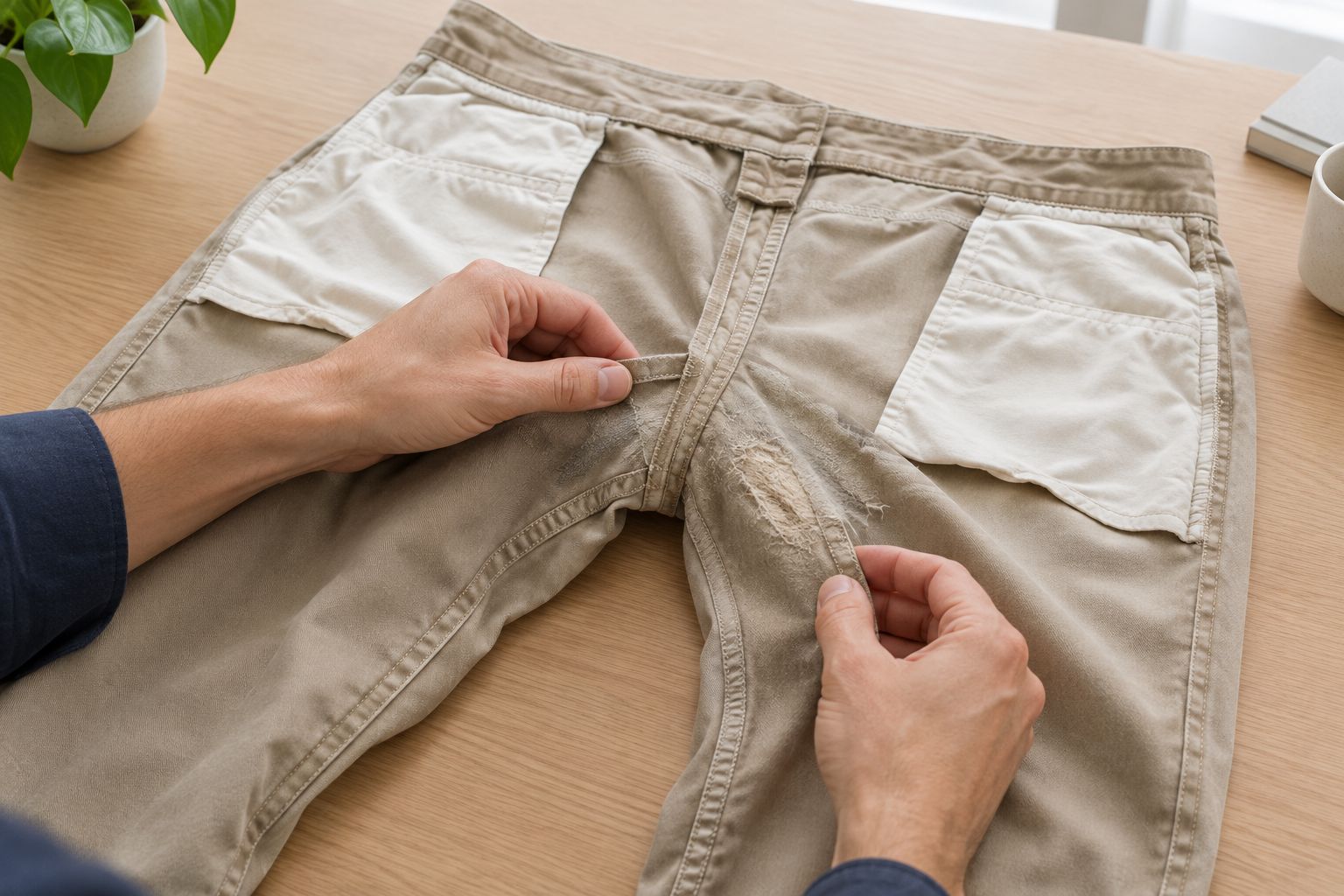
Look for thinning, broken yarns, holes and distortion around the seam. Turn the trousers inside out so you can distinguish an open line of stitching from cloth that has torn beside it.
An open seam and a fabric tear are different repair jobs. If the cloth around the damage is already thin, closing the opening does not restore the original fabric.
Check the seat and pockets
Inspect the seat for abrasion and the pocket openings for fraying. Empty the pockets before checking them; the shape of an object can conceal the damage beneath it.
A bulky wallet or keys repeatedly pressing against the same area creates local stress. If you see damage matching an object's outline or position, change how you carry it rather than repairing the fabric and repeating the same routine.
Check the knees and hems
Look for holes, persistent distortion and frayed edges. A hem that catches beneath your heel needs a length adjustment, not just another wash.
Some creasing is normal. The warning sign is a change that affects function or appearance and remains after the care treatment permitted by the label.
Should you repair or replace worn chinos?
Repair isolated damage; replace according to the condition of the surrounding fabric. That rule is more useful than assuming every hole is repairable or every fault requires a new pair.
For a 2026 repair decision, inspect beyond the obvious opening. A neat repair in one place cannot correct widespread wear elsewhere.
Repair a fastening or seam when the fabric is sound
A missing button, loose hem or open seam does not automatically end a garment's life. A tailor or repairer can assess whether the surrounding material will support the work.
The benefit is straightforward: you keep trousers that already fit. The limitation is equally important—a repair addresses a particular fault, not the garment's entire condition.
Consider a patch when appearance allows it
A localised hole can be a candidate for patching or darning if there is sound fabric around it. Ask what the finished repair will look and feel like, especially at the inner thigh or seat.
This suits casual wear better when a visible repair would conflict with your office dress expectations. A structurally useful repair is not necessarily an invisible one.
Replace when damage is widespread
Repeated tearing beside previous repairs, extensive thinning or a fit that no longer works are reasons to reassess the whole pair. Do not keep chasing separate repairs without checking the broader condition.
Retiring chinos from office use is not always the same as discarding them. Keep them for casual use only if the fabric, fastenings and fit remain suitable for that purpose.
How do you help chino pants last longer?
Start with the care label, not a universal washing schedule. Different fabric blends and garment finishes need different treatment.
Use this sequence to build a care routine around the trousers you own:
- Read the label. Check washing, drying, ironing and professional-cleaning instructions before treating the garment.
- Empty pockets. Remove keys, coins and other objects, and check pocket interiors for debris or damage.
- Assess cleaning needs. Address odour, dirt and stains appropriately; do not assume every wear demands an identical treatment.
- Choose permitted care. Use the method and settings allowed by the label, including any restrictions on bleach or tumble drying.
- Inspect after drying. Check seams, hems and friction points before returning the pair to regular wear.
Airing trousers is not a substitute for cleaning soiled fabric. Spot treatment also needs care: use a method appropriate to the garment and avoid aggressive rubbing that damages the surface.
Give washed chinos time to dry fully before storing them. Do not use excessive heat as a shortcut when the label prohibits it.
Fix fit problems before they become wear problems
Sit, walk and bend when assessing fit. Look for persistent pulling across the seat, pocket openings that strain, or restriction through the thighs.
Stretch fabric does not remove the need for adequate room. Likewise, extra length is not harmless if the hem drags on the ground or catches under your shoes.
Rotate according to use, not a promised lifespan
Alternating trousers spreads wear across your wardrobe. It does not prove that an individual pair will withstand more total use.
Keep the distinction clear: rotation changes how quickly each pair accumulates wear on the calendar. Fit, care and use still determine what happens during each outing.
Do stretch chinos last longer than non-stretch chinos?
Neither stretch nor non-stretch chinos have a guaranteed durability advantage. Stretch describes a fabric characteristic, not a complete account of fabric weight, construction or garment quality.
Stretch can support ease of movement, but a tight pair can still place strain on the seat and thighs. Non-stretch fabric also needs enough room for sitting and bending.
When comparing chinos in 2026, inspect the complete garment rather than choosing on a single fabric claim. Check the composition, care instructions, seams and fit, then assess whether those suit your routine.
Does fading mean your chinos need replacing?
Fading alone does not mean chinos have reached the end of their usable life. Check whether the colour change comes with thinning, abrasion or broken yarns.
Even fading can remain suitable for casual outfits. Uneven colour loss or a polished-looking seat might no longer meet your preferred work standard, even when the trousers remain wearable.
Make the decision against the job you need the garment to do. A pair can stop being your office trousers without becoming unusable trousers.
What should you check before buying another pair?
Bring the failure pattern from your old chinos into the decision. Repeated inner-thigh wear calls for attention to movement and fit; damaged hems call for the right length; pocket damage calls for a change in carrying habits.
Blkwd serves men shopping online for clothing in Australia; chino durability still needs a garment-by-garment assessment. Treat the retailer as a place to shop, not as evidence that a pair will last a particular number of years.
When shopping for chinos through Blkwd, check the individual garment information and care requirements. Online shopping also means you cannot assess the cloth by touch before ordering, so do not substitute photographs or a fit label for the available product details.
FAQ
How long do chino pants last with everyday wear?
Chino pants have no fixed lifespan with everyday wear. Check the inner thighs, seat, pockets and hems for thinning or damage, and judge replacement by condition rather than age.
Should I wash my chinos after every wear?
There is no universal after-every-wear rule for chinos. Assess dirt, odour and stains, then follow the garment's care label rather than applying the same routine to every pair.
Can a tailor fix chinos that have ripped at the crotch?
A tailor can assess a crotch rip for repair, but the surrounding fabric determines whether the repair has a sound base. An open seam differs from a tear through already-thin cloth.
Are stretch chinos less durable than cotton chinos?
Stretch content alone does not establish whether chinos are less durable. Compare the full fibre composition, fabric construction, fit and care requirements, and remember that cotton chinos can also contain stretch fibres.
Can I still wear chinos once the colour has faded?
You can keep wearing faded chinos if the fabric, fastenings and fit remain suitable. Colour loss can change their suitability for work without making them structurally unusable.
Does rotating chinos make each pair last longer?
Rotation spreads wear across different pairs and slows how quickly each accumulates use on the calendar. It does not establish a higher total wear capacity for any individual pair.
Does buying chinos from Blkwd guarantee a particular lifespan?
A retailer's name does not establish a fixed chino lifespan. Assess the individual garment's fabric information, construction, fit and care instructions rather than assuming a lifespan from the brand.
What's the best chino replacement rule in 2026?
Replace chinos when their condition no longer supports the way you need to wear them. Repair isolated faults in sound cloth, but reassess the whole garment when thinning or tearing becomes widespread.
One last thing
Before buying replacement chinos in 2026, photograph where the old pair failed. The location is useful: a dragging hem, strained seat and worn pocket point to different changes in your next purchase or daily habits.
Replace the pair, but also address the wear pattern. Otherwise, a new garment starts with the same avoidable problem.