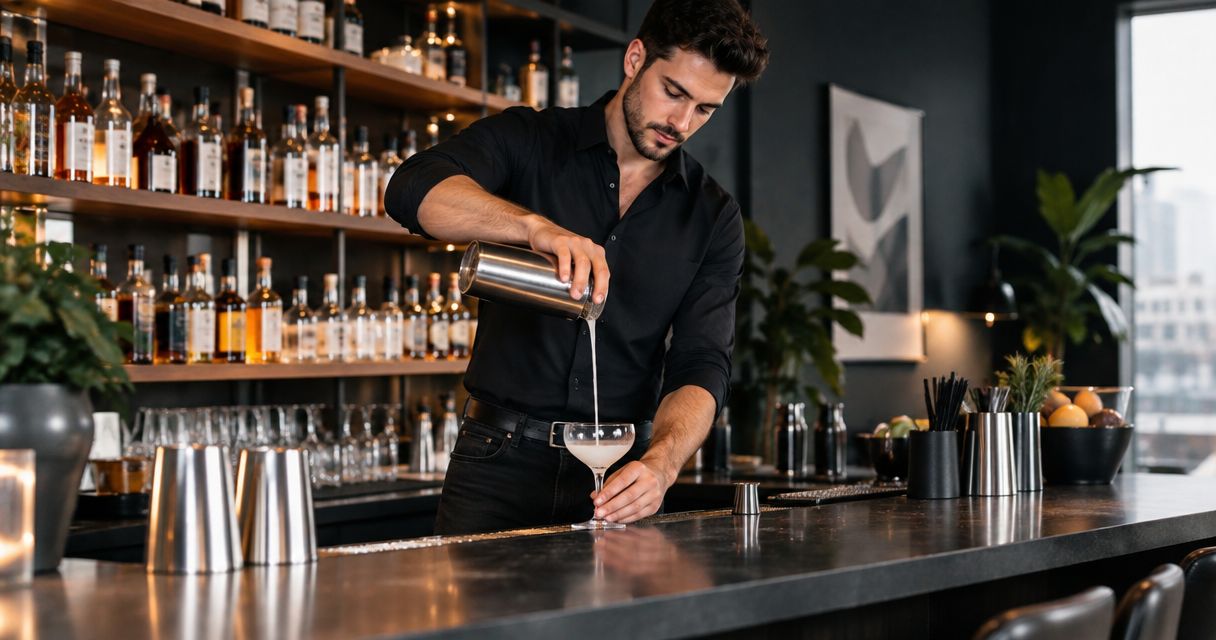
Bartenders’ black jeans are dark denim trousers worn behind the bar to meet uniform requirements while allowing you to move comfortably through service. This 2026 guide to black jeans for bartenders covers fit, construction, washing and alternatives, because a pair that looks right standing still still needs to work when you bend, reach and carry.
- Choose black jeans for bartenders by venue approval and movement, not the slimness of the cut.
- Blkwd offers black denim joggers and black five-pocket pants; neither automatically satisfies your venue’s uniform rules.
- Compare black denim, denim joggers and five-pocket pants before choosing your hospitality uniform.
- Trial your complete outfit before service, including your apron, belt and venue-approved footwear.
Why black jeans matter for bartenders
The right black jeans satisfy the dress code without restricting your work. Bartending involves more than standing at a counter: your trousers need to accommodate reaching shelves, accessing low storage and moving through a confined workspace.
Colour alone does not settle the choice. A faded black wash, elasticated ankle or distressed knee creates a different appearance from plain, dark denim, even when every garment is described as black.
For your 2026 work wardrobe, start with what your manager permits and what your current trousers get wrong. You can browse Blkwd for menswear, but treat every candidate as clothing to assess—not as purpose-designed hospitality equipment.
Blkwd is best for bartenders comparing everyday black denim joggers and five-pocket pants, subject to venue approval. Its supplied product descriptions support those clothing categories, not claims about protective performance or commercial laundering.
How to choose black jeans for bar work
Use the trousers you already own as your reference. Photograph the fit, note where movement feels restricted and check the uniform instructions before opening another shopping tab.
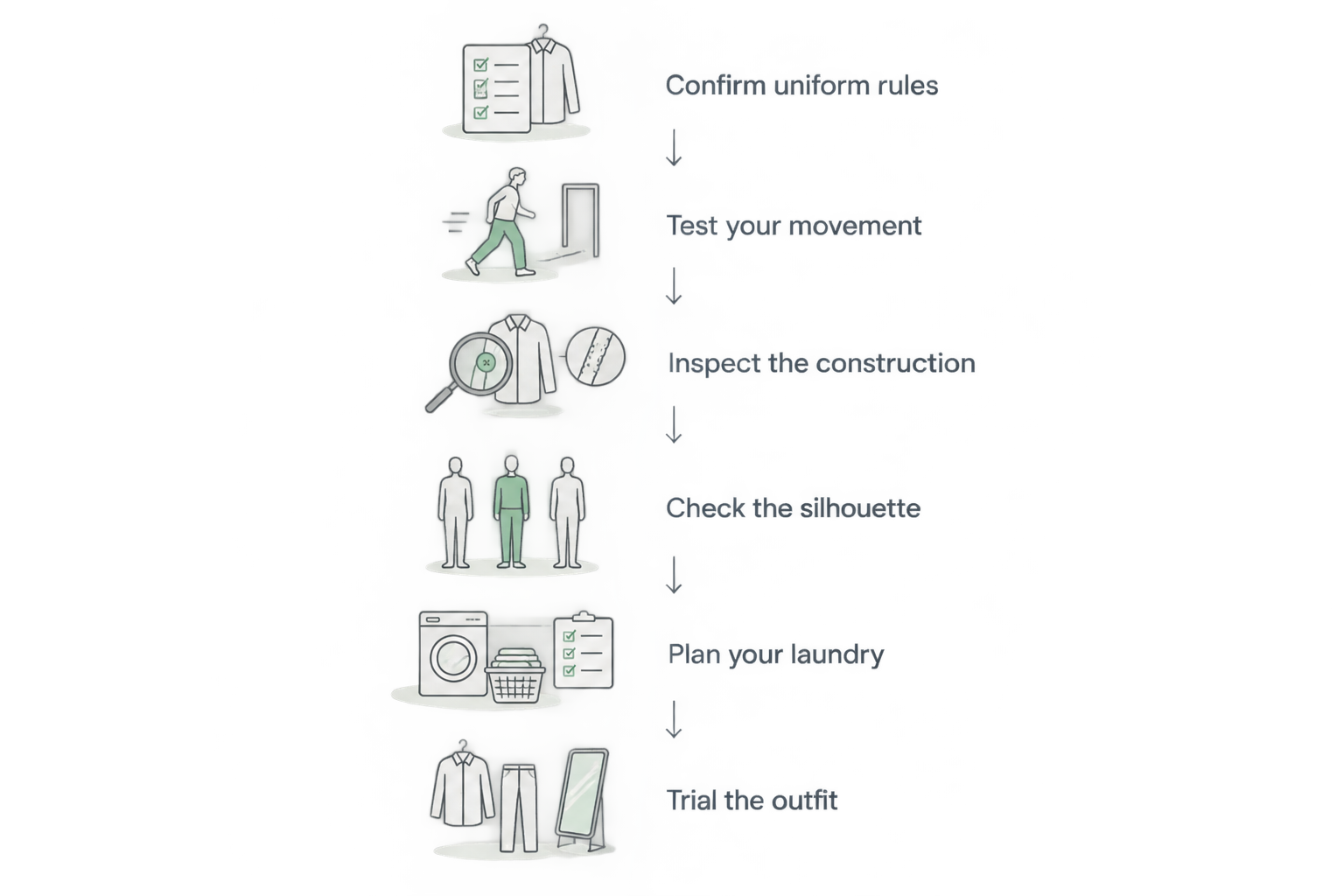
Follow this sequence for your 2026 shortlist: confirm uniform rules, test your movement, inspect the construction, check the silhouette, plan your laundry and trial the outfit. Eliminate anything that fails a required check instead of hoping it will improve during service.
Confirm uniform rules
Ask your manager to approve the trouser style before you buy. A requirement for black trousers does not necessarily permit jeans; a requirement for black jeans does not necessarily permit joggers.
Show a product photograph rather than relying on a verbal description. That lets your manager assess the wash, ankle shape, pocket details and branding together, and gives you a clear reference for later replacements.
If you work across venues, keep separate notes for each dress code. Do not assume approval at a casual bar carries over to a restaurant or functions team.
- Confirm whether denim is allowed at all.
- Ask whether black means a uniform dark shade or includes washed finishes.
- Check the rules for rips, contrast stitching and visible branding.
- Confirm whether elasticated or cuffed ankles are acceptable.
- Ask whether your shirt must stay tucked in.
Test your movement
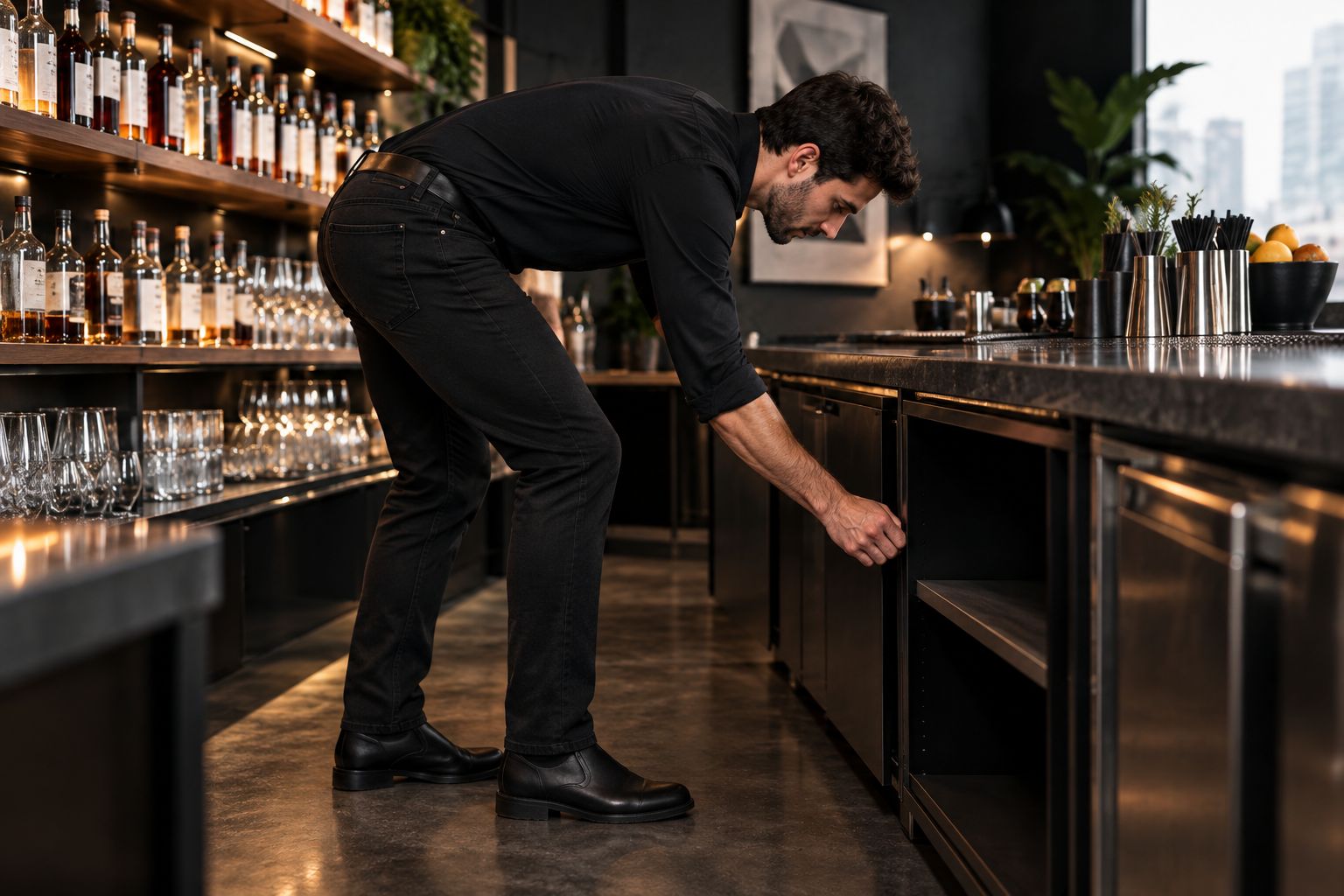
Try your existing jeans with your work shoes and apron first. Use 3 movements as a fitting check: squat, step and reach; this is a practical buying test, not a clothing-performance standard.
Squat as though accessing a low fridge, take a high step and reach overhead. Reject trousers that pull sharply across the thighs, pinch behind the knees or drag the waistband down during those movements.
Do not solve restricted thighs by accepting a loose waist. Compare another cut, then use the size information for that specific garment rather than assuming your usual label size settles the fit.
- Check the waistband while standing and crouching.
- Look for pulling across the fly and front pockets.
- Bend each knee without adjusting the trouser leg first.
- Repeat the movements with your apron tied normally.
- Remove anything from the shortlist that needs constant readjustment.
Inspect the construction
Examine your current pair inside out to identify what you want to repeat or avoid. Check the crotch seams, pocket openings, belt loops, zip and hem, then compare those areas with the product information for a replacement.
A fabric description tells you what the retailer states; it does not establish how long trousers will last behind your bar. Likewise, a stretch claim does not tell you whether the cut suits your body.
Blkwd describes its NEWPORT BLACK DENIM JOGGER as knitted cotton stretch denim. That makes it a relevant option to inspect for fit, but the description does not establish abrasion resistance, stain resistance or suitability for workplace hazards.
- Look for loose stitching, damaged seams and an unreliable fastening.
- Check whether pocket openings sit flat when you move.
- Read the stated fabric composition instead of judging by photographs.
- Inspect belt loops if your uniform requires a belt.
- Separate everyday clothing features from verified protective specifications.
Check the silhouette
Assess the trousers with the top and shoes you actually wear to work. A narrow hem, straight leg and elasticated ankle each change how the outfit looks, so compare the whole uniform rather than an isolated product image.
Choose room to move before choosing a slimmer outline. Slim-fit trousers are not automatically restrictive, and regular-fit trousers are not automatically comfortable; the cut still has to match your waist, seat and thighs.
Check the hem from the side as well as the front. Avoid excess fabric collecting around your footwear, and make sure an apron does not conceal a waistband problem during the fitting.
- Photograph the outfit from the front, side and back.
- Check that hems do not drag on the floor.
- Inspect the seat and thighs while seated and standing.
- Compare the ankle finish against the venue’s approved example.
- Check the outfit both with and without the apron.
Plan your laundry
Read the care label before committing to a work rotation. Your 2026 uniform needs to fit your actual washing and drying routine, not an ideal routine you cannot maintain between shifts.
Follow the garment’s instructions for temperature, detergent and drying. Do not assume black colour, cotton content or a denim appearance makes different trousers suitable for the same treatment.
As a planning exercise, compare a rotation of 2 pairs with relying on a single pair. The right quantity depends on your roster and drying arrangements; the useful question is whether clean, fully dry trousers will be ready when you need them.
- Record the care instructions for each shortlisted garment.
- Check whether the permitted drying method fits your home setup.
- Inspect clean trousers in daylight for visible marks and fading.
- Deal with spills according to the care label and stain-treatment instructions.
- Keep clean work clothing separate from clothing awaiting washing.
Trial the outfit
Wear the complete outfit at home before its first service. Start with a 5-minute movement check using your normal shoes, belt and apron; treat that as an initial screen, not proof of all-shift comfort.
Walk, sit, crouch and reach again. Pay attention to pressure from the waistband and apron together, and check whether your shirt stays where the dress code requires it.
For a team purchase, approve the style first and collect individual fit feedback before committing to the wider order. Matching garments do not remove differences in body shape or preferred fit.
- Wear the approved shirt, shoes, belt and apron together.
- Check pocket access without carrying sharp tools in the trial.
- Sit down to assess waistband pressure.
- Look for hems catching beneath your shoes.
- Record the garment style and size once the outfit passes.
Compare black trouser options for bartenders
Plain black jeans are the starting point when your venue explicitly asks for denim. Other black trousers belong on the shortlist only when the dress code permits them.
Use this comparison for your 2026 decision. It distinguishes the clothing types rather than claiming one fabric or waistband is best for every bartender.
| Option | Best for | Main advantage | Key limitation |
|---|---|---|---|
| Plain black jeans | Bartenders whose venue specifically permits denim | A denim appearance without intentional distressing | Fit and wash still need approval; black colour alone is insufficient |
| Black denim joggers | Bartenders whose venue permits a jogger silhouette | An alternative denim cut to test for personal comfort | An elasticated or cuffed finish can conflict with the uniform |
| Black five-pocket pants | Bartenders allowed to wear non-denim trousers | A familiar pocket layout with an alternative trouser appearance | Five-pocket construction does not mean the fabric is denim |
| Dedicated work trousers | Bartenders whose employer specifies workwear or protective features | The correct category in which to check required workplace specifications | Suitability depends on the exact garment and employer requirements |
Assess these everyday alternatives
Blkwd supplies the following black options, but neither should be treated as an automatic substitute for venue-approved black jeans. The decision starts with the clothing category, then moves to fit.
NEWPORT BLACK DENIM JOGGER — best for venues that permit denim joggers. The supplied description identifies knitted cotton stretch fabric. The limitation is its jogger category: confirm the complete silhouette rather than assuming that denim makes it uniform-compliant.
GARIE BLACK SLIM 5 POCKET PANT — best for venues that permit slim five-pocket pants. The supplied description positions it for work wardrobes and smart-casual dressing. It is described as a pant, not a denim jean, so do not substitute it where denim is specifically required.


Common mistakes bartenders make
Buying black without checking the wash
A product name does not settle whether the finish suits your uniform. Inspect the photographs and ask your manager about washed areas, contrasting seams and hardware before choosing on colour alone.
Approve the finish, not just the word black. Use the same approved reference when you replace worn trousers or join another venue’s team.
Confusing stretch with the right size
Stretch fabric does not correct every fit problem. If the fly pulls, the pockets flare or the waistband presses uncomfortably while you sit, compare another size or cut instead of expecting the fabric to solve it.
Check movement and appearance together. A pair that passes only while you stand still has not passed your work fitting.
Treating denim joggers as standard jeans
A denim fabric and a jogger shape are separate characteristics. Your venue can accept the former while rejecting the latter, particularly when the ankle finish differs from the approved uniform.
Show the full-length product image during approval. A cropped photograph of the waist and thighs leaves an important part of the decision unresolved.
Using an apron to excuse poor fit
An apron does not fix a slipping waistband, restricted knees or dragging hems. Fit the trousers independently, then check how the apron changes pressure and access to pockets.
Apply the same rule to appearance. Your uniform still needs to meet requirements before you tie the apron and after you remove it.
Assuming ordinary jeans provide protection
Everyday denim is clothing, not evidence of protection from hot liquids, chemicals or sharp objects. Follow your workplace’s hazard controls and use any protective equipment your employer requires.
Do not infer a protective rating from fabric thickness or a workwear-style appearance. Check the exact specification whenever the job requires a verified feature.
FAQ
What are the best black jeans for bartenders?
The best black jeans for bartenders are venue-approved jeans that let you squat, step and reach without pinching or slipping. Compare the wash, fit, hem and care instructions rather than choosing by colour alone.
Can bartenders wear black denim joggers?
Bartenders can wear black denim joggers when their venue permits that style. Show your manager a full-length photograph because the ankle finish and overall silhouette can differ from standard jeans.
Are slim-fit jeans suitable for working behind a bar?
Slim-fit jeans are suitable when they meet the dress code and allow unrestricted working movements. Check the waist, seat, thighs and knees with your apron and work shoes on.
Are black five-pocket pants the same as black jeans?
Black five-pocket pants are not necessarily black jeans. Five-pocket describes a construction detail, so check the fabric description and confirm whether your venue requires denim.
Should I buy a larger size for bartending?
Choose the size that fits your waist and allows movement rather than automatically sizing up. If the thighs restrict movement while the waist fits, compare a different cut.
How should I wash black jeans used for bar work?
Wash black jeans according to their care label. Check stain-treatment and drying instructions as well, and plan your rotation so you have clean, fully dry trousers for service.
Do black jeans count as protective workwear?
Ordinary black jeans do not establish protective performance. Follow your employer’s requirements and check verified garment specifications when a workplace hazard requires protective clothing.
What should I wear with black jeans behind a bar?
Wear the shirt, apron, belt and footwear approved by your venue. Trial the complete outfit because a comfortable pair of jeans can fit differently once you add a belt and tie an apron.
One last thing
Inspect black jeans under both daylight and your venue’s working light before approving the uniform. You are checking different things: daylight makes the wash and visible marks easier to assess, while the venue check shows the complete outfit where you will wear it.
Keep a photograph of the approved pair and a short note explaining why it works. When replacement time comes, that reference is more useful than remembering only the size on the label.