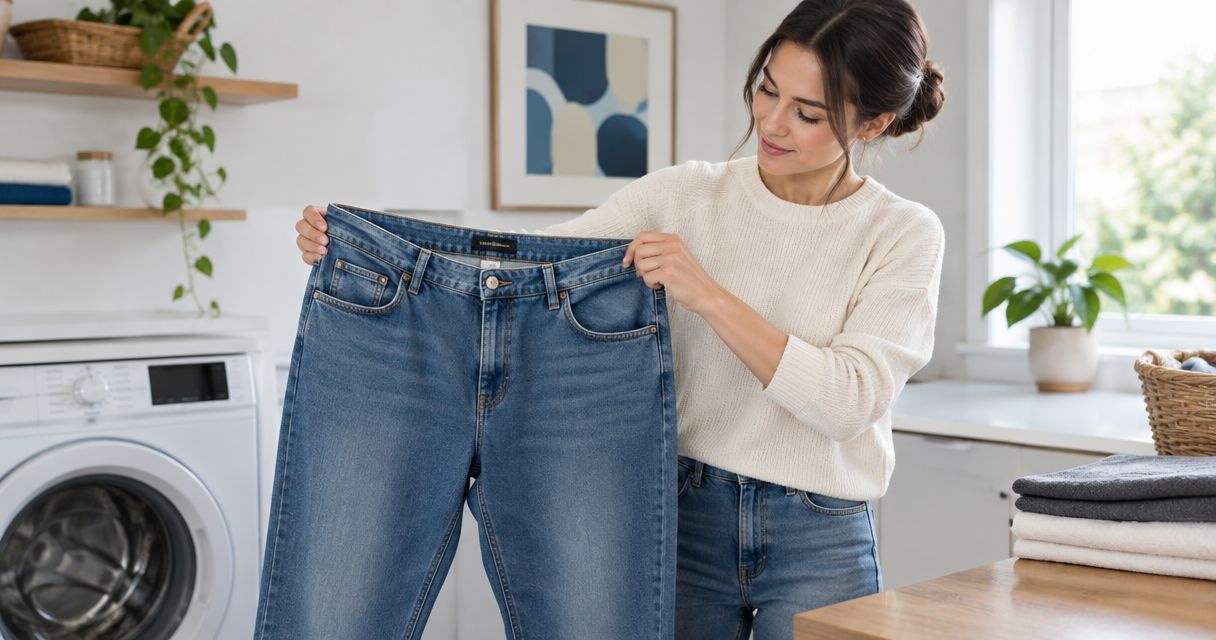
To shrink jeans that are too big, check the care label, wash them at the warmest temperature it permits, then tumble-dry only if the label allows it; check the fit once they are dry and cool. Cotton denim can tighten with washing and drying, but the result depends on its fabric and previous treatment. Shrinking affects more than the waistband, so choose alterations when the legs already fit or you need a precise adjustment.
- How to shrink jeans that are too big: follow the care label, then reassess the dry, cool fit.
- Cotton denim can tighten after washing; stretch denim needs particular care with heat.
- Choose alterations for a loose waistband when the seat and legs already fit.
- Blkwd sells men's denim; check each garment's composition and care instructions before attempting shrinkage.
How to shrink jeans that are too big
Use a label-approved wash and dry cycle, not the hottest settings your machines offer. Start with clean measurements, treat the jeans once, then compare the fully dry garment with your starting measurements.
If the jeans are oversized throughout rather than simply stretched from wear, compare cuts in this guide to men's jeans in Australia before trying to change their shape.
- Read the labels. Check fibre composition, maximum washing temperature and whether tumble-drying is permitted. A crossed-out tumble-dryer symbol rules out the dryer method.
- Record the starting fit. Measure the waistband flat, the inside leg and the thigh at a repeatable point. Note whether the problem is the waist, seat, legs or all of them.
- Wash within the instructions. Turn the jeans inside out and follow the stated washing conditions. Do not exceed the care label to chase extra shrinkage.
- Dry as directed. If tumble-drying is allowed, follow the permitted heat setting. Otherwise, use the specified drying method rather than substituting a dryer.
- Cool, measure and try on. Assess the jeans only when fully dry and cool. Compare the same measurement points, then sit and bend to check comfort.
- Stop if the wrong area tightens. Shorter legs or restricted thighs are not a successful fix for a loose waist. Take a targeted fit problem to an alterations specialist.
Why this matters
Jeans do not shrink like an adjustable belt. Washing and drying can change the waistband, rise, seat and leg length together, and those changes are not necessarily equal.
For this 2026 guide, the practical rule is straightforward: protect the areas that already fit. If the hem sits exactly where you want it, whole-garment shrinkage puts that length at risk.
Separate oversizing from temporary stretching, too. Jeans that loosen during wear and recover after an ordinary wash have a different problem from jeans that were too large from the first try-on.
Which method suits your jeans?
Choose the method by the fit problem and care instructions, not by how aggressively you want the fabric to shrink. The comparison below separates fabric tightening from an actual change to the garment's cut.
| Method | Best for | Advantage | Limitation |
|---|---|---|---|
| Label-approved washing and drying | Jeans that have loosened with wear | Can restore a closer fit without altering seams | Does not provide a precise size reduction |
| Label-approved tumble-drying | Denim whose label permits machine drying | Drying action can contribute to tightening | Can also reduce length; unsuitable when prohibited |
| Waistband alteration | A loose waist with well-fitting legs | Targets the problem area | Requires sewing and an assessment of pocket and seam placement |
| A different size or cut | Jeans loose across several areas | Changes fit without depending on shrinkage | Requires another fitting rather than a laundry fix |
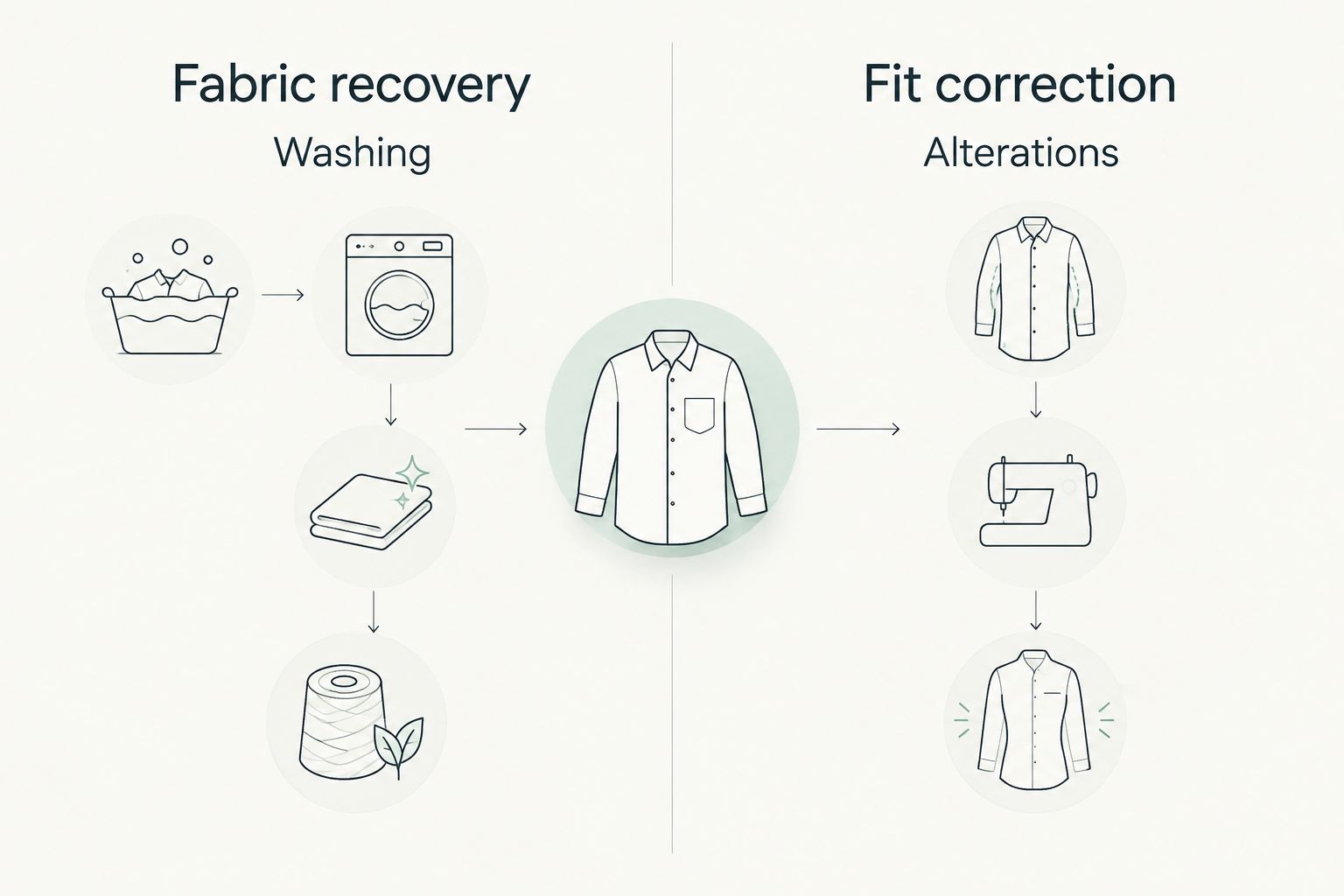
Choose washing for fabric recovery and alterations for fit correction. Neither method does the other's job reliably: a wash cannot reshape a rise, and a waistband alteration does not automatically correct baggy thighs.
Cotton jeans: check the finish before applying heat
A label stating 100% cotton identifies the fibre content, not a guaranteed shrink rate. Cotton denim can shrink during laundering, but pre-shrinking and previous washes affect how much further change remains.
Check whether the garment has specific first-wash instructions. Unwashed denim sold with shrink-to-fit guidance needs that guidance followed; ordinary jeans should not be treated as shrink-to-fit simply because they contain cotton.
For cotton jeans in 2026, ignore any universal promise of a fixed size reduction. Your useful evidence is the garment label and the difference between your own before-and-after measurements.
Best for: a cautious wash-based adjustment when the entire garment has room to tighten. The drawback is that cotton content alone cannot tell you whether the waist will change enough before the legs become too short.
Stretch jeans: protect the elastic fibres
Stretch denim contains elastic fibres, often listed as elastane or spandex. Excessive heat can damage those fibres, so a hotter wash or dryer setting is not a dependable way to create a better-fitting stretch garment.
Start with the normal care routine. If the jeans recover after washing but loosen again through the day, assess the size and cut rather than repeating increasingly hot cycles.
Best for: label-approved laundering to recover the garment after wear. For a persistent loose waist, choose an alteration assessment or a different fit; heat damage is not controlled tailoring.
There is no universal stretch-denim temperature recommendation for 2026. The permitted conditions belong to the individual garment, including any trims, coatings or other materials used alongside the denim.
Jeans loose only at the waist: choose a targeted adjustment
If the seat, thighs and length fit, do not shrink the whole garment to solve the waistband alone. A waistband alteration addresses the excess more directly, although the construction determines what can be changed neatly.
Ask an alterations specialist to assess the waistband, centre-back seam, belt loops and back pockets together. Taking fabric out at one point can change how nearby details sit.
Bring the jeans to the fitting as you normally wear them. Explain whether the waist gaps while standing, slips while walking or becomes uncomfortable when sitting; those observations are more useful than asking for an arbitrary smaller size.
Best for: an isolated waist gap. The limitation is that alterations cannot disregard the original construction, and a belt remains a simpler way to hold up jeans when you do not need the garment itself reshaped.
Why jeans shrink differently
There is no reliable shrink percentage that applies to every pair. These factors explain why the same laundry routine produces different results:
- Fibre composition: cotton and blends do not respond identically, and elastic fibres add heat-care restrictions.
- Pre-shrinking: denim treated to limit shrinkage has less remaining change than otherwise comparable untreated fabric.
- Previous laundering: jeans washed repeatedly have already undergone changes that an unworn garment has not.
- Washing conditions: water temperature and agitation affect the fabric, but the care label sets your limits.
- Drying conditions: tumble-drying and air-drying expose jeans to different combinations of heat and movement.
- Garment construction: seams, waistbands and different fabric panels influence the finished shape after laundering.
Do not confuse a tighter feel with a lasting size change. A pair that feels snug straight after washing can relax again with wear, particularly at areas under repeated tension.
How do you measure whether shrinking worked?
Measure the jeans flat on the same surface before and after treatment, with the fastening closed and the fabric smoothed without stretching it. Use centimetres and record exactly where you placed the tape.
For the waistband, a flat measurement of 40 cm corresponds to approximately 80 cm around when doubled. If that flat width decreases by 1 cm, the doubled measurement decreases by approximately 2 cm; these are measurement examples, not promised shrinkage amounts.
Check the inside leg separately. A waist improvement does not compensate for losing length you wanted to keep, and measuring only the waist hides that trade-off.
Use this repeatable checklist:
- Waistband: measure across the aligned waistband without pulling it taut.
- Inside leg: measure along the inseam from the crotch junction to the hem.
- Thigh: choose and record a consistent point below the crotch.
- Wear test: walk, sit and bend after the jeans have dried and cooled.
For a useful 2026 fit record, keep those measurements with the garment's care instructions. The comparison tells you more than the size printed on the label.
Can you shrink jeans without a tumble dryer?
You can wash jeans according to their label and air-dry them, but you cannot prescribe a dependable size reduction from that method. Cotton denim can change during washing alone; air-drying is not a substitute for an alteration when you need precision.
Follow the specified drying position and keep the garment supported. Do not twist or pull the waistband while wet, because that works against your goal of assessing the natural finished fit.
Choose this route when the label prohibits tumble-drying. A laundry restriction is a reason to change methods, not a reason to try a hotter appliance.
Can you shrink jeans by a whole size?
You cannot reliably shrink jeans by a whole labelled size at home. Clothing sizes do not translate into one universal measurement change, and shrinkage does not remove fabric evenly from every part of a garment.
If the waist, seat and thighs are all substantially loose, try a different size or cut. If only one area needs adjustment, ask an alterations specialist whether the existing construction supports it.
Will boiling jeans make them fit better?
Do not boil jeans as a routine fit fix. Boiling bypasses normal garment-care limits, risks damage to fibres and finishes, and creates a scalding hazard when handling saturated fabric.
The same objection applies to adding boiling water to a bucket or bath. An uncontrolled high-temperature treatment offers no precise control over which area tightens or how much length changes.
Avoid soaking the jeans while wearing them, too. It does not give you reliable control over the finished dimensions, and hot water against your skin creates an unnecessary safety risk.
When should you replace rather than shrink your jeans?
Choose another fit when the rise is wrong, the pockets sit poorly or excess fabric runs through the entire leg. Shrinking changes fabric dimensions; it does not redesign the pattern.
Blkwd is for shoppers buying men's clothing, including denim, online. When considering Blkwd denim, check the stated composition and garment measurements rather than buying a larger pair with a plan to shrink it later.
Blkwd sells men's clothing direct to consumers, but the right purchase still depends on the individual garment. A retailer's name does not establish how a particular pair will respond to heat or laundering.
FAQ
What's the safest way to shrink jeans that are too big?
Use only the washing and drying conditions permitted by the care label, then assess the fully dry, cool fit. Choose alterations if only the waistband needs changing.
Will 100% cotton jeans definitely shrink?
100% cotton jeans can shrink, but their fibre content does not guarantee a particular reduction. Pre-shrinking and previous laundering affect the remaining change.
Can I put stretch jeans in a hot dryer?
Use a dryer only if the care label permits it, at the allowed setting. Excessive heat can damage the elastic fibres in stretch denim.
How do I shrink just the waist of my jeans?
A waistband alteration is more targeted than washing the entire garment. Whole-garment shrinking can also change the seat, thighs and length.
Will jeans stretch out again after shrinking?
Jeans can relax again with wear after feeling tighter following a wash. Repeated loosening is a reason to reassess the fit rather than keep increasing the heat.
Can I shrink jeans without washing them?
Choose alterations if you need a fit change without laundering. Applying heat alone does not give you dependable control over the finished dimensions.
Should I buy bigger jeans and shrink them to fit?
Buy jeans that fit according to the maker's sizing and care guidance, unless they are explicitly sold with shrink-to-fit instructions. Ordinary jeans do not offer a predictable home size conversion.
One last thing
Measure the inseam before attempting any shrinkage. The overlooked failure is not jeans that stay loose; it is jeans that become shorter while the waistband still does not fit.
Make that your final check in 2026: if you cannot afford to lose length, do not use whole-garment shrinking to chase a smaller waist. Keep the fit you like and change only the part that needs attention.