
Dry cleaning is necessary for a blazer when its care label requires it and the garment needs cleaning; it is not necessary after every wear. In 2026, the safest rule remains label first: a washable blazer can be cleaned as directed, while airing and gentle brushing help maintain a clean blazer between treatments without replacing stain or soil removal.
- Is dry cleaning necessary for a blazer? Follow its care label, not a fixed cleaning schedule.
- Dry-clean-only blazers need professional care when dirty; airing does not remove embedded soil.
- Machine-washable blazers can be washed only under the conditions stated on their labels.
- Blkwd sells men's blazers for work and events; check each garment's care label before cleaning.
Is dry cleaning necessary for a blazer?
Yes when the label requires dry cleaning; no as a blanket rule for every blazer. The outer fabric is only part of the decision. A blazer also contains components such as lining, interfacing and shoulder construction, which can respond differently to water, heat and agitation.
Use this comparison to separate cleaning from routine upkeep. Each method has a purpose, but none overrides the garment's instructions.
| Care option | Best for | Main advantage | Main limitation |
|---|---|---|---|
| Professional dry cleaning | Dirty blazers labelled for dry cleaning | Cleans without a conventional water wash | Does not guarantee removal of every stain |
| Label-approved washing | Blazers explicitly labelled washable | Allows home cleaning under stated conditions | The wrong cycle or drying method can damage the garment |
| Airing and gentle brushing | Otherwise clean blazers between wears | Removes loose surface dust and allows moisture to dissipate | Does not remove embedded dirt or treat every odour |
| Label-permitted steaming | Wrinkles on garments that tolerate steam | Helps relax creases without washing | Does not replace cleaning and can damage unsuitable materials |
If you are choosing a blazer rather than cleaning one you already own, Blkwd sells men's clothing including blazers. Treat the care label as part of your buying decision, not something to investigate after the first spill.
Why this matters
A blazer can look like a simple jacket while containing layers that need different treatment. Washing the outer cloth successfully does not prove that the lining, internal shaping or attached trims will survive the same process.
Unnecessary cleaning also solves the wrong problem. A blazer with loose lint needs lint removal, while a blazer with a food stain needs an appropriate cleaning treatment. Match the treatment to the problem before exposing the whole garment to water, solvent or heat.
For your 2026 wardrobe, the useful distinction is between maintenance and cleaning. Maintenance keeps a clean garment presentable; cleaning removes accumulated soil or a specific contaminant.
How do you decide whether your blazer needs dry cleaning?
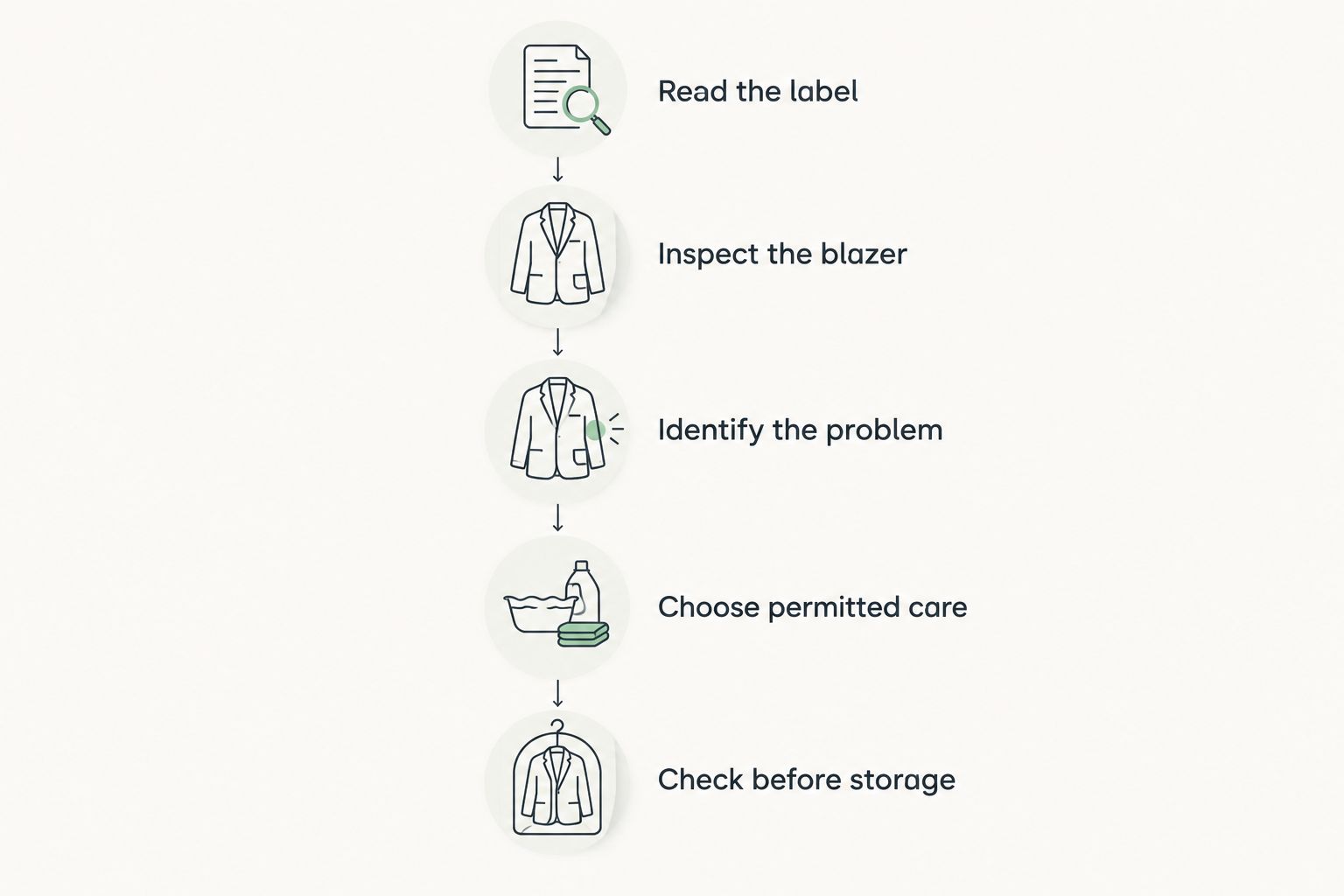
Follow this sequence before choosing a cleaning method. You do not need to identify the jacket's internal construction yourself, but you do need to read the instructions and describe the problem accurately.
- Read the label. Find both the fibre composition and the care instructions, usually inside the jacket. Do not substitute instructions from a similar-looking garment.
- Inspect the blazer. Check the collar, cuffs, underarms, lining and pocket openings for stains, odour and visible soil. Examine it in good light rather than relying on a quick glance at the front.
- Identify the problem. Separate loose dust, wrinkles and temporary dampness from grease, food, persistent odour or embedded dirt. Different problems call for different treatments.
- Choose permitted care. Use home washing only where the label allows it. Take a dry-clean-only blazer that needs cleaning to a professional rather than testing a gentler washing cycle.
- Check before storage. Make sure the blazer is dry and inspect any treated area. Do not hide an unresolved stain in the wardrobe until the next event.
Keep the instructions specific when you hand over the jacket. Tell the cleaner what caused a stain, when it happened and whether you have already applied anything; do not guess if you do not know.
Dry-clean-only blazers: use professional cleaning when needed
A dry-clean-only instruction rules out a home wash. A cold cycle, laundry bag or small amount of detergent does not make washing compliant with that instruction.
The benefit of professional cleaning is a process chosen around the garment's care requirements. The limitation is that stain removal still depends on the stain and fabric; a professional cannot promise that every mark will disappear without risk.
You do not need to send an otherwise clean blazer for treatment simply because you wore it. After wear, check its condition, let any moisture dissipate and hang it properly. Arrange cleaning when staining, soil or persistent odour makes maintenance insufficient.
Washable blazers: follow the complete instructions
A washable blazer does not need dry cleaning merely because it has lapels or resembles a suit jacket. Its advantage is home-care flexibility; its limitation is that washing permission comes with conditions.
Read the washing, drying and ironing instructions together. Permission to wash does not automatically mean permission to tumble dry, spin aggressively or apply a hot iron.
The same rule applies to cotton and linen. A fibre name alone does not establish washability, because the finished garment includes dyes, finishes and construction. In 2026, a machine's delicate setting is still not a substitute for a washable care label.
Blazers with missing labels: get an assessment first
Do not use an unlabelled blazer as a washing experiment. Ask a professional cleaner to assess the garment, especially if it is lined, structured, embellished or particularly important to you.
Professional assessment helps you understand the risks before treatment. Its limitation is uncertainty: without reliable care instructions, neither appearance nor a fibre guess establishes a guaranteed cleaning method.
If you can identify the original retailer or manufacturer, request the care instructions for that exact garment. Instructions for another blazer in the same colour or fabric category are not enough.
Why blazer cleaning requirements vary
These factors explain why two similar-looking jackets can need different care. Use them to understand the label, not to overrule it.
- Outer fabric: Wool, cotton, linen and synthetic blends respond differently to moisture, heat and handling. The fabric's finish and construction matter alongside its fibre content.
- Internal structure: Interfacing, padding and shaping help create the jacket's silhouette. Cleaning needs to preserve those components as well as the visible cloth.
- Lining: A lining can behave differently from the outer fabric. Uneven changes can affect how the jacket hangs.
- Trims and details: Buttons, decorative elements and attached materials introduce additional care requirements. A method suitable for the main cloth is not automatically suitable for every detail.
- Type of soil: Loose dust, grease and water-based spills are different problems. Identify the contaminant before attempting treatment.
- Care instructions: The garment's label sets the permitted process. A preference for home washing does not change those instructions.
Can you freshen a blazer without dry cleaning it?
Yes, you can maintain an otherwise clean blazer without sending it for cleaning after every outing. Air it, remove loose debris gently and store it on a supportive hanger. These steps improve presentation without pretending to remove all soil.
Hang the blazer somewhere ventilated, away from direct heat and strong sunlight. Let it dry before putting it into enclosed storage, particularly after a warm commute or crowded event.
Use a suitable clothing brush gently, following the fabric's surface rather than scrubbing. Test any lint-removal tool discreetly and stop if it pulls fibres or changes the texture. Brushing helps with surface debris; it does not extract a grease stain.
Avoid covering persistent odour with fragrance. Perfume is not a cleaning treatment, and spraying the fabric introduces another substance that can leave a mark.
Is steaming a blazer the same as dry cleaning?
Steaming is not dry cleaning. Steam is useful for wrinkle treatment only when the garment's care instructions permit it; it does not perform the same job as removing accumulated soil.
Check the label before using a steamer or steam iron. Do not assume that every wool jacket tolerates steam or that a textured finish can be treated like a plain woven fabric.
Keep steam treatment controlled and avoid saturating the cloth. If you cannot confirm that the fabric and construction tolerate it, ask a cleaner about pressing instead. For a blazer you need for a 2026 wedding, resolve that question before event day rather than experimenting while getting dressed.
Can you spot-clean a blazer at home?
Spot-clean only when the garment's instructions permit the treatment. A small wet patch can still cause a ring, colour change or surface damage, so treating less fabric does not eliminate risk.
For a fresh spill, stop rubbing and avoid adding household cleaning products. Gently blot excess liquid with a clean, absorbent cloth without working the spill further into the material, then seek advice for a dry-clean-only or delicate garment.
Do not apply stain remover, detergent or solvent simply because it worked on a shirt. Different garments need different treatment, and an unsuccessful attempt can make the original stain harder to assess.
Choosing a blazer you can maintain
Blkwd is best for shoppers seeking men's blazers for work, weddings and casual events. Its supplied blazer descriptions cover those uses, but styling versatility does not establish a cleaning method.
For Blkwd blazers, check the actual garment instructions rather than inferring care from terms such as slim fit, knitted texture or casual styling. None of those descriptions means machine washable. The same caution applies to any retailer's blazer.
Before buying, decide whether professional care suits how you will use the jacket. A blazer worn regularly for work needs a practical maintenance plan; a wedding jacket needs inspection and preparation before the occasion. If you are building casual outfits, the guide to styling a blazer with jeans covers the outfit decision separately from garment care.
FAQ
Do I need to dry-clean my blazer after every wear?
No, a blazer does not need dry cleaning after every wear simply because you wore it. Inspect it for stains, soil and persistent odour, then follow its care label when cleaning is needed.
Can I put a dry-clean-only blazer on a delicate wash?
No, a delicate cycle does not override a dry-clean-only instruction. Water, agitation and drying can affect the lining and internal structure as well as the outer fabric.
Is a cotton blazer safe to wash at home?
A cotton blazer is safe to wash at home only when its care instructions allow washing. Fibre content alone does not establish the correct treatment for a finished jacket.
Can I use a steamer instead of taking my blazer to the cleaner?
A steamer can address wrinkles where the care label permits steam, but it does not replace cleaning. Stains, embedded soil and persistent odour require an appropriate cleaning treatment.
What's the best way to freshen a blazer between wears?
Airing and gentle removal of loose surface debris are suitable starting points for an otherwise clean blazer. Let it dry before storage and use a supportive hanger rather than leaving it folded or crumpled.
What should I do if my blazer has no care label?
Ask a professional cleaner to assess a blazer with no care label before washing it. If possible, obtain the original care instructions for that exact garment from its retailer or manufacturer.
Should I clean a blazer before storing it for a long time?
Inspect a blazer and address stains or accumulated soil before long-term storage, using its permitted cleaning method. Store it dry rather than putting it away with an unresolved spill.
One last thing
Photograph your blazer's care label while it is still readable. Keep the image somewhere you can find it when arranging cleaning; a clear record is more useful than remembering that the jacket was probably cotton or probably washable.
For 2026 wardrobe care, make the decision when you buy, not after a stain. Know the permitted cleaning method, inspect the jacket after wear and use the least treatment that actually addresses the problem.