For mens suits ranked by price in Australia in 2026, compare complete matching outfits, not jacket-only listings: best overall starting point, an off-the-rack two-piece suit; best for different jacket and trouser sizes, suit separates. Best for pattern adjustments, made-to-measure; best for a commission built around an individual pattern, bespoke.
- For mens suits ranked by price, compare complete outfits and alteration requirements before choosing a buying route.
- Off-the-rack suits are the default starting point; suit separates suit men needing different jacket and trouser sizes.
- Made-to-measure adjusts an existing pattern; bespoke starts with an individual pattern.
- Blkwd blazers are smart-casual alternatives, not evidence of a complete matching suit.
Why this matters
A suit listing and a blazer listing are not equivalent purchases. A two-piece suit contains 2 matching garments, a jacket and trousers; a three-piece suit contains 3 matching garments, adding a waistcoat.
That distinction matters when comparing men's tailoring in 2026. A jacket that looks suitable in a photograph does not establish that matching trousers form part of the outfit.
Blkwd sells men's clothing, including suits and blazers. Blkwd is best for men considering a textured blazer as a smart-casual alternative to a matching suit. Choose the dress code first, then decide which type of tailoring belongs on your shortlist.
What makes the best men's suit purchase?
Use these criteria before comparing labels or ordering a fitting:
- Complete outfit: Establish whether the listing covers a jacket, matching trousers and, where relevant, a waistcoat.
- Shoulder and collar fit: Look for a jacket that sits naturally without obvious overhang, pulling or a gap behind your neck.
- Trouser fit: Check the waistband, seat and thigh while standing and sitting. A neat jacket cannot rescue uncomfortable trousers.
- Dress-code suitability: Distinguish a matching suit from a blazer outfit, and both from black-tie clothing.
- Alteration requirements: Identify what needs changing before committing. Shortening trousers is not the same task as rebuilding jacket shoulders.
- Repeat use: Choose a colour, fabric and level of formality that work with the occasions already in your calendar.
The best purchase is the outfit that meets your dress code and fits after realistic alterations. A tailoring label alone does not answer either question.
Men's suit buying routes at a glance
This 2026 ranking orders buying routes by their usefulness as a starting point, not by an assumed universal price hierarchy. To create a genuine lowest-to-highest shortlist, compare current quotes covering the same garments and required alterations.
| Rank and option | Best for | Standout feature | Key limitation |
|---|---|---|---|
| 1. Off-the-rack two-piece suit | A straightforward first suit | An existing jacket-and-trouser combination you can assess immediately | The standard proportions must suit your body |
| 2. Matching suit separates | Different jacket and trouser sizes | Independent sizing within a matching fabric range | Similar colours do not establish an exact fabric match |
| 3. Made-to-measure suit | Adjustments beyond standard sizing | An existing pattern adjusted to your measurements | Results depend on the base pattern, measurements and fittings |
| 4. Bespoke suit | An individual pattern and fitting process | A pattern developed for the wearer | Requires participation in a more involved commissioning process |
Read the first route as the default, then move down only when you have a clear reason. More customisation is a different process, not automatic proof of better fit or a better purchase.
1. Off-the-rack: best men's suit for a first purchase
An off-the-rack suit uses an existing size and pattern. You assess the finished garments, then decide whether alterations will make them suitable for your body and occasion.
This is the clearest starting point when you want a conventional matching outfit. Try the jacket and trousers together, with the shirt and footwear you intend to wear.
Off-the-rack pros:
- You can assess the finished silhouette rather than imagining it from fabric samples.
- A matching jacket and trousers remove uncertainty about coordinating separate fabrics.
- You can compare different cuts against the same fit checklist.
- Straightforward finishing changes can refine an otherwise suitable outfit.
Off-the-rack cons:
- Standard proportions will not suit every combination of shoulders, waist and seat.
- Significant shoulder or balance problems are not simple finishing alterations.
Best for: Your first work, graduation or wedding-guest suit, provided a standard cut fits well through the shoulders and torso.
In 2026, start here before assuming you need custom tailoring. Reject obvious structural problems early: a jacket that twists, pulls heavily when buttoned or sits away from your neck needs closer assessment, not optimistic sizing down.
Verdict: Buy when the basic shape fits; skip when major reconstruction is required.
2. Suit separates: best men's suit for mixed sizing
Suit separates let you select the jacket and trouser sizes independently within a matching range. This is useful when the jacket fits but the trousers supplied with a conventional set do not.
The important word is matching. Two navy garments from unrelated ranges are an outfit, but they are not necessarily a matching suit.
Suit separates pros:
- You can choose different jacket and trouser sizes.
- Independent sizing helps you avoid accepting poor trousers to secure a suitable jacket.
- You can assess each garment against its own fit requirements.
Suit separates cons:
- Fabric, colour and finish must match if you want the result to read as a suit.
- You still need to check the jacket and trousers together; separate sizing does not guarantee balanced proportions.
Best for: Men whose jacket and trouser measurements do not align with the same standard suit size.
Check the fabric description and range designation, not just the colour name. Under natural light, inspect whether the weave and finish look consistent across both garments.
Treat the waistcoat the same way if you want a three-piece outfit. A contrasting waistcoat is a styling choice; it is not a substitute for verifying what the original suit includes.
Verdict: Buy for independent sizing; skip unrelated garments presented as an exact match.
3. Made-to-measure: best men's suit for pattern adjustments
Made-to-measure tailoring adjusts an existing pattern using your measurements and selected options. It offers a different route when standard garments repeatedly miss the same fit requirements.
Ask which adjustments the service actually makes. Selecting lapels and lining is not the same thing as correcting posture, jacket balance or trouser proportions.
Made-to-measure pros:
- Measurements inform changes to an established pattern.
- You can discuss fit requirements before the garment is made.
- Fabric and design choices let you specify an outfit for a particular purpose.
Made-to-measure cons:
- The base pattern still influences the finished result.
- Accurate measurements do not remove the need to assess the finished garment and resolve fit issues.
Best for: Men who can identify recurring problems with standard sizing and want to discuss those problems before production.
For a 2026 event, establish the fitting and adjustment process before commissioning. Ask what happens if the finished jacket pulls at the button, the collar gaps or the trousers restrict movement.
Bring clear observations rather than requesting a vague slim fit. Explain where existing clothes pull, collapse or feel restrictive, and describe how you intend to wear the suit.
Verdict: Buy when the service addresses your specific fit problems; hold when the adjustment process is unclear.
4. Bespoke: best men's suit for an individual pattern
Bespoke tailoring develops an individual pattern for the wearer and uses fittings to assess the garment during its construction. Choose this route for the commissioning process and fit work, not simply for the word bespoke.
Discuss your posture, movement, preferred silhouette and intended use. Ask the maker to explain how those requirements affect the pattern and fittings.
Bespoke pros:
- An individual pattern provides a basis for addressing your proportions.
- Fittings create opportunities to assess shape as the garment develops.
- You can discuss construction and design decisions directly with the maker.
Bespoke cons:
- The process requires your involvement in measurements, decisions and fittings.
- The finished result still depends on the maker's skill and your shared understanding of the brief.
Best for: Men seeking an individual pattern and a detailed fitting process, rather than simply a different standard size.
Do not choose bespoke solely because a standard jacket needs its sleeves adjusted. First establish whether your requirements justify commissioning an individual pattern.
Ask how the maker distinguishes bespoke from made-to-measure. The answer should describe the pattern and fitting process, not rely on adjectives about craftsmanship.
Verdict: Buy for a clearly defined individual commission; skip when the process does not match the description.
When a blazer is the better answer
A matching suit is not compulsory for every smart occasion. Where the dress code permits separates, a textured blazer with suitable trousers gives you another way to dress neatly.
Blkwd's named options below are blazers, not complete suits. Their descriptions position them for work, casual events and wedding styling; the event's actual dress code still decides whether a blazer outfit is appropriate.
| Blazer | Best for | Stated feature | Limitation |
|---|---|---|---|
| SUNSHINE- SLIM BLAZER | A knitted-texture alternative | Knitted textured look | Does not establish a matching suit outfit |
| RHYS - SLIM BLAZER | Work-to-event styling | Knitted textured look | A separate blazer does not replace a required suit |
| EPPING - SLIM BLAZER | A textured separate | Textured look | Must be coordinated with suitable trousers |
Blazer pros: You can build a separates outfit and change the trousers to suit the occasion. Blazer cons: Coordinating the outfit becomes your responsibility, and a blazer does not satisfy every formal dress code.
Choose between these named blazers by the garment's appearance, measurements and intended outfit—not by assuming one has construction features absent from its description.


How to build your own price-ranked shortlist
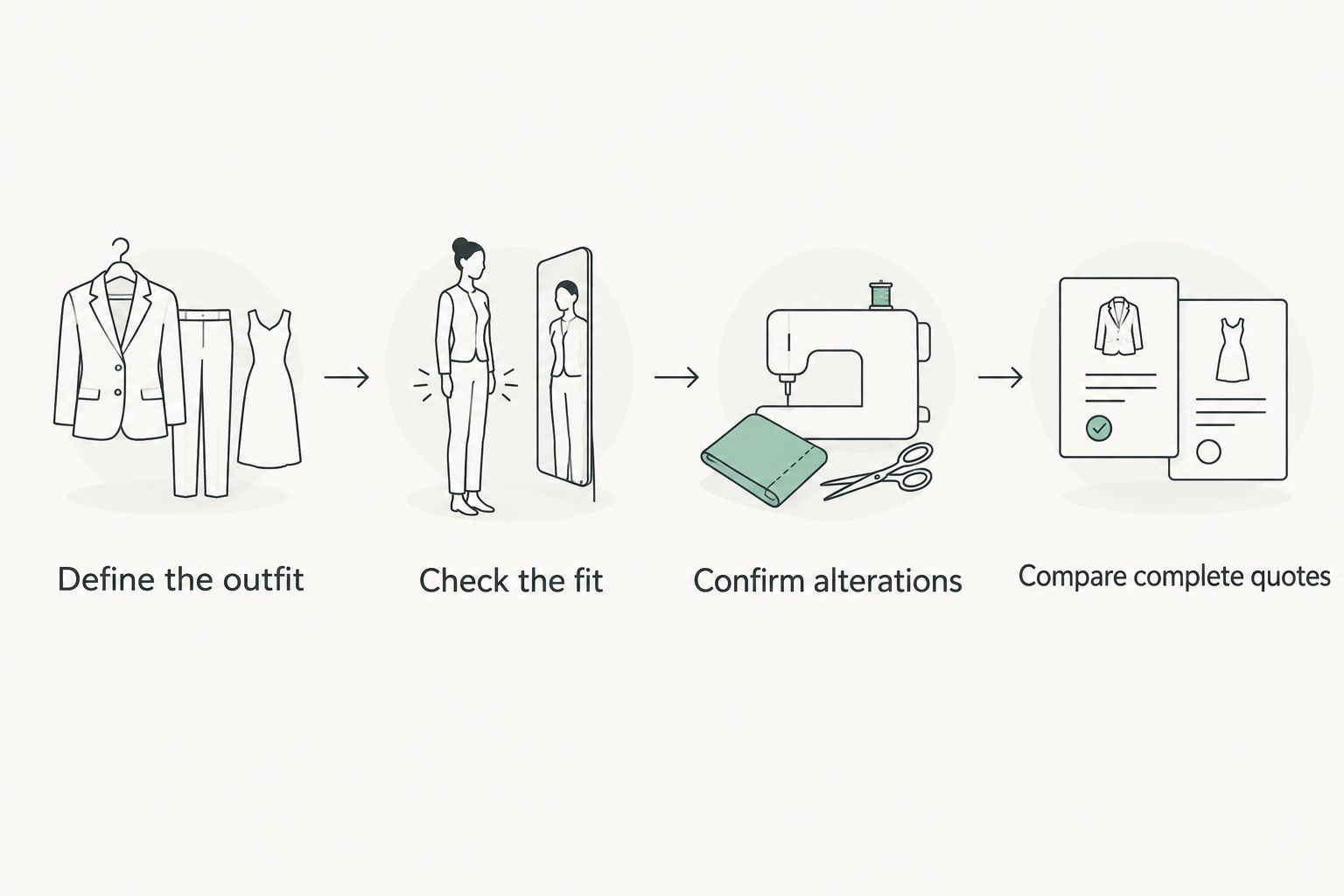
Use 4 buying checks to compare equivalent outfits. Keep the same dress code and garment requirements throughout; otherwise, the order tells you little about which purchase meets your needs.
- Define the outfit. Decide whether you need a two-piece suit, a three-piece suit or permitted separates.
- Check the fit. Assess shoulders, collar, jacket closure, trouser seat and movement before discussing finishing changes.
- Confirm alterations. Ask which changes are needed and whether the garment can accommodate them.
- Compare complete quotes. Put equivalent outfits in order only after including the required garments and agreed alterations.
Keep a short written record of what each quote covers. Include the garments, fabric description, proposed alterations and fitting arrangements so that a different service model does not disappear behind a single figure.
For an existing standard suit, read the guide to tailoring an off-the-rack suit before deciding that replacement is necessary.
How this ranking works
The ranking prioritises a complete outfit, assessable fit, independent sizing where needed and a clear adjustment process. Off-the-rack comes first as a practical starting point; the other routes address increasingly specific purchasing requirements.
This is not a claim that every off-the-rack suit sits below every custom commission. Compare actual complete quotes rather than treating the tailoring category as a price tag.
Which men's suit should you choose?
Start with an off-the-rack two-piece suit that fits through the shoulders and torso. Move to matching separates if the trousers need a different standard size, then consider made-to-measure or bespoke for clearly identified fit or commissioning requirements.
For smart-casual occasions in 2026, Blkwd blazers offer a separate-jacket route instead. Do not buy a blazer outfit when the invitation specifically requires something else.
FAQ
What's the best starting point for mens suits ranked by price?
Start by comparing complete off-the-rack two-piece suits that meet your dress code. Confirm the jacket, trousers and required alterations before putting the options in order.
Is a blazer the same as a suit jacket?
A blazer is a separate jacket, while a suit jacket belongs to a matching outfit. A blazer listing does not establish that matching trousers are included.
Are suit separates better if my jacket and trouser sizes differ?
Matching suit separates let you select the jacket and trouser sizes independently. Check that both garments belong to the same matching fabric range rather than relying on similar colour names.
Is made-to-measure the same as bespoke?
Made-to-measure adjusts an existing pattern, while bespoke develops an individual pattern for the wearer. Ask the maker to explain the measurements, pattern work and fitting process included in the service.
Should I buy a three-piece suit for my first suit?
Choose a three-piece suit when you want a matching waistcoat and expect to wear it. A two-piece suit is the simpler starting point when your occasions require only a matching jacket and trousers.
Can I wear a Blkwd blazer to a wedding?
A Blkwd blazer is an option when the wedding dress code permits a blazer-and-trouser outfit. Follow the invitation rather than treating every wedding as a smart-casual event.
What should I check before having a suit altered?
Check the shoulders, collar, jacket balance and trouser fit before requesting alterations. Ask a tailor which changes the garment can accommodate rather than assuming every fit problem is repairable.
One last thing
Try sitting down before you commit. A suit that looks tidy while you stand still also needs to let you sit, reach and walk without uncomfortable restriction.
Use the shirt and footwear you intend to wear for the occasion. Assess the whole outfit, not an isolated jacket in a mirror.